
Table of Contents

 3 April 2026 (updated)
 Will a Battery Charger Charge a Completely Dead Car Battery?
Often, a standard car battery charger will not charge a completely dead, or deep-discharged, battery. This is because modern ‘smart’ chargers require a minimum voltage to be present in the battery before they will begin the charging cycle. If the battery's voltage is too low, the charger will not recognise that it is connected to a battery and will remain inactive as a safety precaution. However, this does not always mean the battery is beyond recovery.
Understanding why this happens and what your options are can save you from the unnecessary expense of a new battery. The key is to differentiate between a battery that is simply flat and one that is permanently damaged.
Why Most Modern Chargers Fail with Dead Batteries

The majority of battery chargers on the market today are intelligent or 'smart' chargers. They are designed with safety features to prevent common issues like incorrect polarity connection or attempting to charge an unsuitable battery type. To perform these safety checks, the charger's internal microprocessor needs to detect a stable voltage from the battery. This minimum detection threshold is typically low — often somewhere between 1 and 3 volts depending on the model — but a completely dead battery, particularly one that has been left discharged for an extended period, can fall even below this level, reading close to zero volts at the terminals.
A completely dead battery, especially one that has been left discharged for an extended period, can fall below this voltage threshold. The charger interprets this lack of voltage as either a faulty battery or an incorrect connection and, for safety reasons, refuses to deliver any current. This safety mechanism, while effective at preventing damage, can be misleading. The charger's refusal to engage does not automatically mean the battery is faulty; it is crucial to perform a physical inspection to distinguish between a recoverable battery and one that is permanently damaged and unsafe.
When Is a Battery Truly Beyond Saving?
Before attempting any form of recovery, it is crucial to inspect the battery for signs of terminal damage. If you notice any of the following, do not attempt to charge the battery under any circumstances, as it could be dangerous:
- A swollen or cracked case: This indicates internal damage or freezing, which can lead to leaks or even an explosion.
- Leaking fluid: The sulphuric acid inside a battery is highly corrosive. Any sign of leakage means the battery casing is compromised.
- A strong, rotten egg smell: This pungent odour can indicate the presence of sulphur compounds — possibly hydrogen sulphide gas — and may suggest the battery is overheating or has a serious internal fault.
If any of these signs are present, the battery is unsafe and must be replaced. Attempting to charge it poses a significant risk.
Sold by AUTODOC Sold by AUTODOC Sold by AUTODOC Sold by AUTODOC Sold by AUTODOC
 Article number: 11-997
£113. 99price incl. 20% VAT, excl. delivery costs
Article number: 11-997
£113. 99price incl. 20% VAT, excl. delivery costs
 VARTA Battery
12V 80Ah 740A Lead-acid battery
Article number: 5804000743132
£103. 99price incl. 20% VAT, free delivery
VARTA Battery
12V 80Ah 740A Lead-acid battery
Article number: 5804000743132
£103. 99price incl. 20% VAT, free delivery
 Article number: EL1050
£147. 99price incl. 20% VAT, free delivery
-13%
Article number: EL1050
£147. 99price incl. 20% VAT, free delivery
-13%
 Article number: OBSL400
compared to
RRP
£167.91
£145. 49price incl. 20% VAT, excl. delivery costs
Article number: OBSL400
compared to
RRP
£167.91
£145. 49price incl. 20% VAT, excl. delivery costs
 BOSCH Battery
12V 70Ah 630A Lead-acid battery
Article number: 0 092 S40 260
£95. 49price incl. 20% VAT, free delivery
BOSCH Battery
12V 70Ah 630A Lead-acid battery
Article number: 0 092 S40 260
£95. 49price incl. 20% VAT, free delivery
How to Revive a Completely Dead Battery
If the battery shows no signs of physical damage, it may be possible to recover it by prompting your smart charger to begin a charging cycle. Before attempting any of the methods below, always consult your vehicle's owner's handbook. On many modern vehicles — particularly those manufactured from around 2018 onwards — a Battery Management System (BMS) monitors all power entering and leaving the battery. Bypassing this system, or connecting additional power sources incorrectly, can damage sensitive electronics. Your handbook will confirm the correct procedure for your specific vehicle.
Important: Always consult your vehicle's owner's handbook before attempting this procedure. Manufacturer instructions for your specific vehicle take precedence over general guidance.
Safety First: Always wear protective gloves and safety glasses when handling car batteries. Ensure you are working in a well-ventilated area, as batteries can release flammable hydrogen gas during charging.
Step 1 — Try your charger's built-in recovery mode first
Many modern smart chargers include a dedicated "Force Mode" or recovery function, specifically designed to initiate charging on a battery that has dropped below the normal detection threshold. If your charger has this feature, consult its manual and attempt this before anything else — it is the safest and simplest option for most users.
Step 2 — If no Force Mode is available: the parallel method
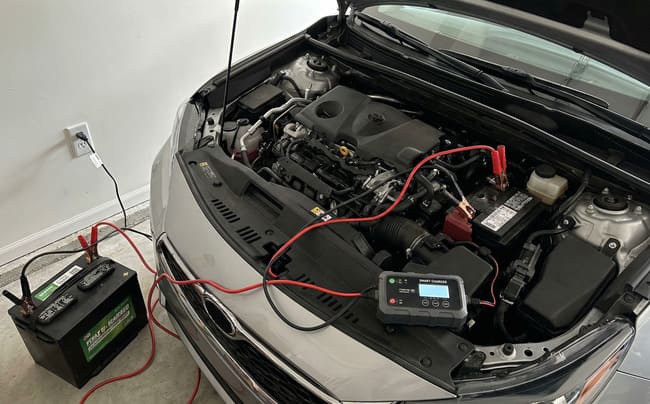
If your charger lacks a recovery mode, it is sometimes possible to temporarily raise the dead battery's voltage using a healthy, fully charged 12V car battery and a set of jump leads, allowing the smart charger to detect sufficient voltage and begin its cycle. However, this method carries additional risk on vehicles equipped with a Battery Management System (BMS). On many modern vehicles, the BMS sensor sits on or near the negative battery terminal and monitors all current flow. Introducing a second power source alongside the charger can send unmonitored current through the system, potentially causing the BMS to log a fault or display a warning that requires a garage reset to clear. Before attempting this method, you must consult your vehicle's owner's handbook to confirm it is appropriate for your specific vehicle and to identify the correct connection points.
- Connect the Batteries in Parallel: Place the healthy battery next to the dead one, ensuring they do not touch. Connect the positive (red) jump lead to the positive terminal of the healthy battery, and then connect the other end to the positive terminal of the dead battery.
- Connect the Negative Terminals: Connect the negative (black) jump lead to the negative terminal of the healthy battery. For the other end, do not simply look for any unpainted metal surface on the engine block — on many modern vehicles, plastic engine covers and acoustic shielding make this difficult and unreliable. Instead, consult your vehicle's owner's handbook, which will identify the manufacturer-approved earth point for your specific model. This is commonly a designated metal bracket, bolt, or earthing stud away from the battery, fuel lines, and brake pipes. BMS configurations vary between manufacturers, and on some vehicles the approved connection point may differ from conventional practice — making it especially important to follow your handbook precisely. Do not connect the final negative clamp directly to the dead battery's negative terminal. Making this final connection away from the battery reduces the risk of a spark igniting any flammable gases the battery may be emitting.
- Attach the Charger: Now, connect your smart charger to the battery. Connect the red clamp to the battery's positive terminal. For a battery fitted in the vehicle, connect the black clamp to a suitable earth point on the vehicle chassis, away from fuel lines, rather than directly to the battery's negative terminal. If the battery has been removed from the vehicle, connect the black clamp to the negative terminal in the usual way. If you are unsure of the correct procedure for your vehicle, consult the owner's handbook.
- Begin Charging: With the jump leads and charger connected, plug in and switch on the smart charger. The voltage from the healthy battery will raise the overall voltage of the circuit, allowing the smart charger to detect the battery and initiate its charging cycle.
- Monitor and Disconnect: Leave everything connected for 5–10 minutes. Once the charger has started its cycle and is delivering a steady current, you can switch off and disconnect the jump leads in the reverse order of connection, keeping the leads clear of any moving parts. Allow the smart charger to continue charging the battery on its own. A full charge can take anywhere from 8 to 24 hours, depending on the battery's condition and the charger's amperage.
Costs of Professional Help vs. Replacement
If you are not comfortable attempting this procedure, or if it fails to revive the battery, your next step is either professional testing or a full replacement. A battery that has been deep-discharged may have suffered permanent damage (sulfation) and may no longer hold a charge effectively, even if it can be temporarily revived.
| Service / Product | Typical UK Cost | Notes |
|---|---|---|
| Professional Battery Test | £0 – £35 | Many suppliers offer free battery health checks. |
| Standard Car Battery (Supply Only) | £75 – £160 | For most common petrol and diesel cars without stop-start technology. |
| AGM/EFB Battery (Supply Only) | Prices vary considerably depending on the battery's capacity, technology, and brand | Required for modern vehicles with stop-start systems. |
| Professional Fitting Labour | Fitting costs vary by vehicle type and provider. Basic fitting at national chains starts from a modest sum, but vehicles with stop-start systems or BMS requirements typically attract a higher rate to cover the additional coding or registration work involved. | Cost varies by vehicle and provider. Always confirm the total fitted price — including any BMS registration or coding charge — before booking, as this can increase the overall cost significantly compared to a straightforward swap. Independent garages and vehicles requiring electronic coding may cost considerably more. |
Sold by AUTODOC Sold by AUTODOC Sold by AUTODOC Sold by AUTODOC Sold by AUTODOC
 Article number: 605102080A742
£148. 99price incl. 20% VAT, free delivery
Article number: 605102080A742
£148. 99price incl. 20% VAT, free delivery
 BOSCH Battery
12V 60Ah 540A Lead-acid battery
Article number: 0 092 S40 050
£83. 99price incl. 20% VAT, free delivery
BOSCH Battery
12V 60Ah 540A Lead-acid battery
Article number: 0 092 S40 050
£83. 99price incl. 20% VAT, free delivery
 Article number: EL550
£82. 99price incl. 20% VAT, free delivery
-11%
Article number: EL550
£82. 99price incl. 20% VAT, free delivery
-11%
 Article number: U1
compared to
RRP
£59.86
£52. 99price incl. 20% VAT, free delivery
Article number: U1
compared to
RRP
£59.86
£52. 99price incl. 20% VAT, free delivery
 BOSCH Battery
12V 90Ah 720A Lead-acid battery
Article number: 0 092 S30 130
£113. 49price incl. 20% VAT, free delivery
BOSCH Battery
12V 90Ah 720A Lead-acid battery
Article number: 0 092 S30 130
£113. 49price incl. 20% VAT, free delivery
Conclusion
While a modern smart charger often will not charge a completely dead battery on its own, it is frequently possible to recover the battery using a secondary power source to initiate the charging process. Always prioritise safety by inspecting the battery for physical damage before you begin. If the battery is swollen, leaking, or smells strongly, it must be replaced and disposed of responsibly.
Car batteries are subject to strict regulations under the Waste Batteries and Accumulators Regulations 2009 and must not be placed in household waste or general bins. They can be taken to a Household Waste Recycling Centre (HWRC), dropped off at many garages and automotive retailers, many of whom will accept them — particularly as part of a new battery purchase, or left with the specialist who fits your replacement battery. Under UK regulations, producers and distributors have a legal duty to collect waste automotive batteries free of charge from professional final holders such as garages and scrapyards; however, private individuals are generally expected to dispose of old batteries via an HWRC or by handing them over when a replacement is being fitted.
Should you determine that a replacement is necessary, sourcing the correct part is crucial. For an exact match to your vehicle's specifications, including advanced AGM or EFB batteries for stop-start systems, AUTODOC provides a comprehensive catalogue with a vehicle selector tool to help identify batteries suited to your make, model, and engine. When browsing, always compare the listed dimensions, capacity, voltage, and battery technology against your vehicle's existing specification and Battery Management System (BMS) requirements. If you are unsure about compatibility, our customer service team is on hand to help — simply get in touch via live chat with your VIN for tailored guidance.


