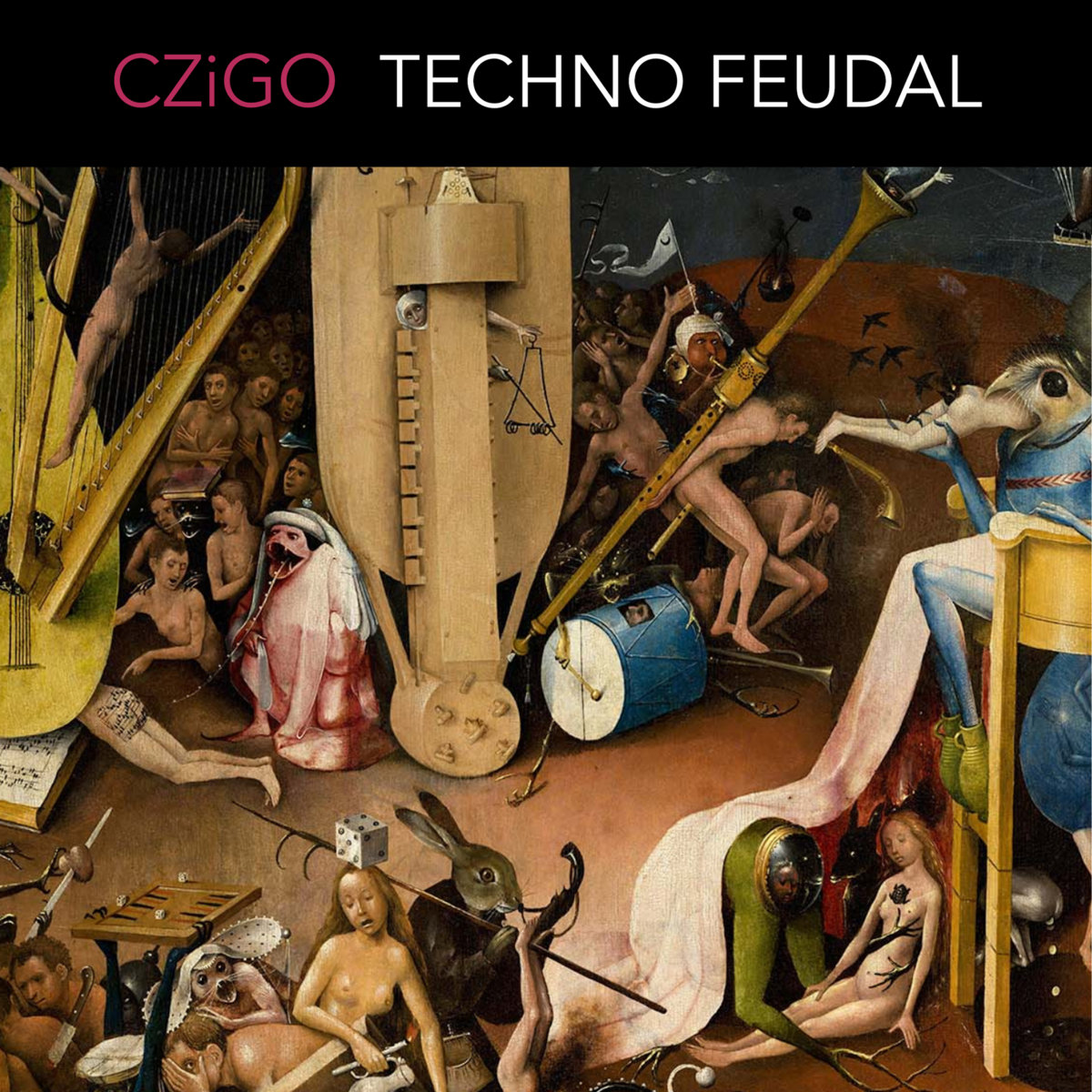
In December, we’re pleased to welcome back CZiGO aka Mark Donlon with an expressive and emotionally resonant third album release on Machine Records.
Following earlier albums ‘Aishroo’ in 2023 and ‘Actant Theory’ in 2024 comes ‘Techno Feudal’, which Mark describes as “a dystopian vision in which the human struggles to maintain their relevance and authenticity.”
The title was inspired by Yanis Varoufakis’ book ‘Technofeudalism’. “In the two years since Varoufakis’s book, technology, specifically Artificial Intelligence, has developed with a rapidity that seems to have blind-sided the world,” Mark says. “The implications for all of us are of course, quite scary and unpredictable, not the least for music.”
“My reaction to all this was first of all, to essentially eschew ‘digital tools’, courtesy of AI/machine learning, that have been proliferating in music production. So, ‘Techno Feudal’ has very different terms of reference from the probability algorithms of ‘Actant Theory’. This album is wholly ‘made by human hand’, or should I say human mind.”
“Underlying my approach to creative process was the desire to foreground the human-ness of music making.”
Mark is a jazz pianist, composer, conductor, educator and music producer. He’s released techno/electronica albums on Sermak Music (
sermakmusic.bandcamp.com) as well as jazz albums on the F-IRE and Fuzzymoon record labels. He’s recently lived in Aotearoa New Zealand and the UK.
We caught up with Mark to talk about his new album.
Machine: After relocating from Aotearoa New Zealand, you’ve been back in the UK for a little while now. Tell me a bit about what you’ve been up to musically since then. How has that affected your approach/experience?
Mark: The main thing about being back home has been the opportunity to rekindle old musical relationships. Compared to Aotearoa New Zealand, there is a much bigger and more happening scene here, which is also (refreshingly) more diverse. I have found myself, as a pianist, re-exploring playing Cuban Music, Salsa and Latin Jazz, which are pretty much a non-existent thing in Aotearoa; there just aren't the players who can really do it, sad to say. One live project I have been contributing to involves Latin Dance Music interacting with electronics - some effects of that, I feel, have permeated my electronic music since I got back to England.
Lately, I was more consciously aware of my intentions embracing how hip-hop music can influence my drum programming/ beat making, however on reflection there are tracks on ‘Techno Feudal’, which I had intended to be the most overtly ‘Techno’ on the album, such as the title track and 'Pandemia', that seem to have rhythmical features that come from Latin music. A track on ‘Actant Theory’, which was the first album I made back here in the UK, is the result of experimentation with ways of manipulating electronic tools such as MIDI effects, controlling pitch, timbre and spatial parameters, for improvising in real time — so I could improvise ‘electronically’ in a way that correlates to an Afro-Cuban sound world .
Machine: How did this new album come about? What was important for you in approaching it and how did that experience/approach compare to ‘Actant Theory’?
Mark: The title ‘Techno Feudal’ refers to the recent book by economist and former Greek finance minister Yanis Varoufakis: ‘Technofeudalism’. Since this book was published in 2023, the term has become a buzz word for political commentators.
When I read the book, I had been working on ‘Actant Theory’ and I was looking for a premise for my next project. I actually chose the title for the album before even starting on the music, which is unusual for me; usually titles come after the musical conception. I have to confess initially my choice of that title was for rather shallow reasons. I had in mind that I wanted to do a ‘Techno’ album, since I've been strongly motivated to draw my dance-floor music roots deeper into my creative electronic music (if that makes sense). So ‘Techno Feudal’ had an appeal because it seemed quite catchy! I had no desire to do some kind of political polemic, though.
Machine: I remember we talked a while back about doing a t-shirt...
Mark: Pluralism has always been a key aspect of my music. I draw on a diverse range of musical forms and contexts from the world that we live in today. From ‘Actant Theory’ onwards, I think I have been aiming to draw these different threads together into a coherent whole. As well as that, I have increasingly found that I have been moving towards there being (for lack of a better term) extra-musical concepts driving the music. I think that in the past I was striving towards something akin to ‘absolute music’, as per the aesthetics of Eduard Hanslick.
I would say that I used to find it difficult to give my compositions titles, once they were finished and that those titles were often disconnected with the music. Over time, I have noticed that non-musical ideas, visual images, books etc. seem to spark off my music. This was not the result of a conscious decision to change, it just seems to have happened that way spontaneously.
Since I originally decided to run with the Techno Feudal theme, events in the world have developed that have made fertile grounds for ideas that have sparked off the music. ‘Techno Feudal’ is a dystopian vision in which the human struggles to maintain their relevance and authenticity. The cinematic quality that has been an increasing factor in my music features strongly; particularly in tracks like ‘O Wretched Creature’ and ‘Ancient Alien Dub’, with soundscapes that aim to evoke the nightmarish dystopian visuals like H.R. Giger’s artwork.
Machine: These tracks could definitely fit well in the soundtrack of the recent ‘Alien: Earth’ show. In general, we seem to be moving suddenly from a period where we were joking about how the future wasn’t how sci-fi films predicted it… to a more unsettling feeling that it’s becoming exactly what was predicted.
Mark: In the two years since Varoufakis’s book, technology, specifically Artificial Intelligence, has developed with a rapidity that seems to have blind-sided the world. The implications for all of us are of course, quite scary and unpredictable, not the least for music. Global digital platforms, such as Spotify are already being swamped and dominated by AI slop, with artists increasingly being replaced by non-existent avatars. A lot of babies have been thrown out with a lot of bath water; talk is rife in the corporate, cultural, and educational corridors of power of a future where creative artists make new music by the use of ‘prompts’ and AI instead of being able to play, compose, or produce their own music.
Added to that, there are deep, generalised anxieties about a dystopian future ruled by inhuman computers. It is too early to assess how much of it is media hype; it is always possible that this could be the 21st century equivalent of the 17th century Dutch Tulip Bulb bubble…
Machine: The level of AI hype is bewildering. I can’t recall ever witnessing anything like it. So far I can’t see a technology that matches the wild claims being made, but of course that could change.
Mark: My reaction to all this was first of all, to essentially eschew ‘digital tools’, courtesy of AI/machine learning, that have been proliferating in music production. So, ‘Techno Feudal’ has very different terms of reference from the probability algorithms of ‘Actant Theory’. This album is wholly ‘made by human hand’, or should I say human mind.
Underlying my approach to creative process was the desire to foreground the human-ness of music making. Since I rely on using a DAW to create electronic music and I don't currently have access to analogue equipment or studio facilities, I focused on using sound-design techniques to ‘manually’ craft sounds from essential waveforms (e.g using additive and subtractive synthesis techniques) and field recordings, as the basis for the sonic materials, using various forms of ‘sample mangling’ and glitching.
Machine: I really enjoyed the sense of space on these tracks.
Mark: Spatial elements do figure a lot in this album. My detailed use of dynamic panning reflects this music not being intended as ‘club music’. In a way, it is more akin to a sonic installation or to be listened using a good stereo sound system in an optimal space. In some way, I think of it as being a sonic exhibition. I have used automated panning and dynamic use of spatial effect such as reverb and delay for expressive reasons.
Machine: That makes a lot of sense to me. As a listener, I was really struck by the rich, expressive quality of the sound.
Mark: There is a definite contrast regarding intentions and process in ‘Techno Feudal’, with how I was seeking to integrate probability algorithms with improvisation in ‘Actant Theory’, where the starting point had been computer-generated elements, to which I responded with improvisation and composition/production.
For this album, I used three words from a recording of a speech by Varoufakis that I thought were apposite: ‘…training the machine…’. This sample appears most recognisably, and becomes subject to progressive mangling, in the track ‘Training the Machine’. Beyond that track, the ‘Yannis’ sample plays a central role in the whole album. It is the basis for much of the sonic material. for example, the nightmarish screeches and squawks in 'Ancient Alien Dub' and the sinister, inhuman chattering sounds in 'O Wretched Creature' are derived from that sample, as are many of the percussion sounds, glitches, transients and textures that appear in the drum programming. To my mind, this contributes to the overall sonic coherence and unity of work as a whole.
Machine: The ‘Techno’ element is easy to grasp, but what about the ‘Feudal’ side of things?
Mark: I remember when I was first starting this project, I expressed to you the intention to reference medieval music practices, (probably motivated by the feudalism thing!) I didn't want to turn this into a pastiche of some kind of Techno/medievalist dance music, though. Strangely, as an aside, I've always thought that a lot of main-room German Techno club music sounds like a modern version of medieval and pre-Renaissance secular music - and of course, there was the turn-of-the-century (20th) ‘Techno Viking’ viral meme from Matthias Fritsch, which got a strong hold on image/fashion in Berlin Techno Clubs.
The first track.'Techno Feudal', does aim to evoke a ‘quasi-pre-medieval tribal hunter’s-ritual-dancing’ vibe, as is suggested by the track-title. However, rather than my trying to ape melodic and rhythmic features from early/medieval music, there are hidden features embedded deeply in the music throughout the album, some are very obscured and some more explicit, carrying codified meaning. Hidden codes and references are characteristic of much Medieval and Renaissance music.
Machine: Intriguing! What are some examples of that?
Mark: Well, the track ‘Move Fast and Break Things’ (as per Mark Zukerberg’s motto) twice includes the Hironymous Bosch ‘Butt Song’. To explain, this is the melody that is written on the backside of one of the characters in the hell-scape section of Bosch’s 15th century painting ‘Garden of Earthly Delights’. I think I'm trying to say here that Social Media has condemned us to a kind of hell that tortures us with our follies, conceits and delusions.
In ‘Ancient Alien Dub’ Jerry Goldsmith’s famous ‘alien chord’ is transformed, using audio effects, into a rhythmic groove-pattern, which to my mind connects with the H.R. Giger imagery that I mentioned earlier. If you listen carefully, you can hear it. The ‘Butt Song’, however, is more concealed, so that will be harder to spot.
A couple of the tracks are somewhat off-theme: ‘Karesansui’ is the word for Japanese Zen Gardens where plants and other objects are juxtaposed simply for meditation. This piece is intended as a memorial for the 6th of August 1945. 'Home to Glory’ is in memory of the singer Roberta Flack, who passed away recently.
Machine: It’s a moving piece. I found the whole album very emotionally resonant, in fact.
Mark: ‘Techno Feudal’ has taken (for me) quite a long time gestating. The way it turned out is very different from how I originally had envisaged it. This is not at all unusual in creative work; I definitely think though, that I have grown new things by working on this and about that, I am pleased.
released December 12, 2025
Made by Mark Donlon.