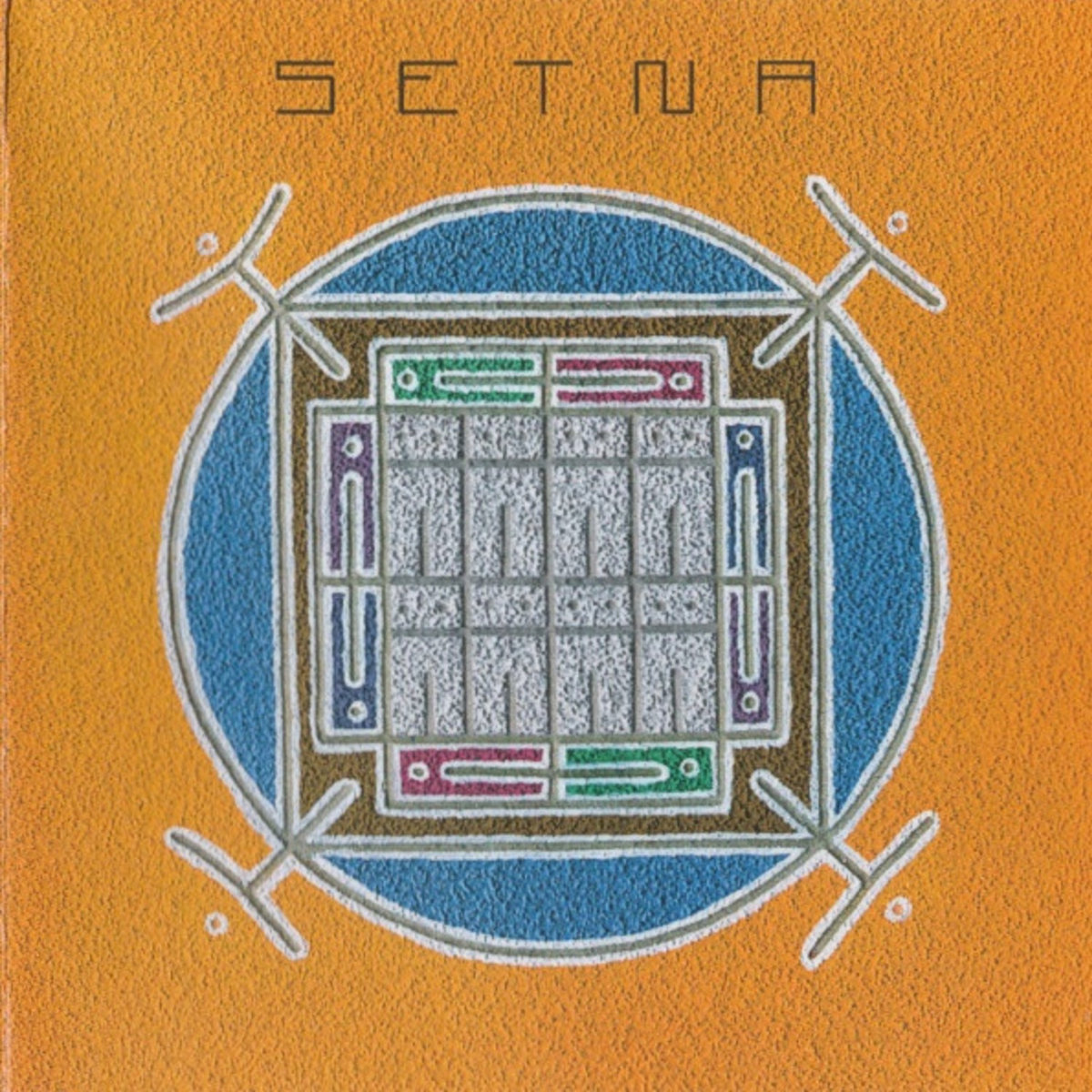
SETNA’s second album, with contributions from Yannick Duchene (vocals) from NEOM and Benoît Widemann (Moog). At the crossroads of progressive and zeuhl – 3 long suites (9.52 / 26.16 / 14.58) plus 2 bonus tracks from the recording sessions.
While it is obvious that Setna’s scarcity in both music stores and concert venues is also
(if not above all) due to pragmatic reasons (which is confirmed by his leader Nicolas Candé in the interview accompanying this review), it is tempting to see in this parsimony the expression of an artistic ethos dictating that the band should only manifest themselves when they think they have something truly important to say, beyond the (perfectly legitimate and mutual) satisfaction of giving us the latest progress report on their musical evolution – in this case, and this isn’t insignificant, the long-awaited follow-up to Cycle I (2007), one of the most finest French progressive albums in recent memory.
Before even considering his music in the light of critical considerations (an “objective” description of his music and a subjective assessment of its value), it must be noted, since it’s so obvious to the eyes (and ears) that a “spiritual” aura emanates from Setna that largely transcends their stylistic reference points, and gives their music a much more universal resonance. As such, one is advised to read the booklet notes while listening, as they usefully put the music in perspective. While conceptual arguments often look like a way to artificially lend coherence and depth to something that lacks either, they also underline in this case a striking correspondence between the indications given and their musical incarnation.
Of course, the universality of its emotional essence does not detach Setna’s music from any historical and musical frame of reference. Indeed it is anchored in the Zeuhl school (the triptych formed by the haunting Fender Rhodes motifs, the powerful and sometimes fuzz bass, and drums that are in turns propulsive and pacifying), but with more than ever before, elements of the Canterbury sound (in the combination of refined melodies and complex rhythms), as explicitly underlined by the occasional use of the fuzz organ sound characteristic of the genre.
Not wanting to lock Setna into this particular web of references – this will, at least, have the merit of making a potential audience aware that they will find much to enjoy about their music (and it is hard to imagine they would be disappointed upon hearing it), this is probably the only criticism that could possibly be directed at the Rouen-based band: that of working in a sound aesthetic that is objectively “dated” to a time a good forty years ago, in both its sound and style. But this “purism”, which some may see as retrograde, is only an antidote to all that was wrong about the 1980s sound, of which it was said at the time that it had “outdated” those of the previous decade, an argument few would still advance nowadays. Ultimately, the fact is that many of the strongest albums that have recently appeared in the genre (Änglagård springs to mind) are rooted in what some have called a backward attitude, but is actually just an aspiration to sound timeless.
But let’s leave aside theoretical issues and explore the content of Guérison in more depth. Unlike Cycle I, conceived as a single entity, this second album is presented as three long, distinct suites lasting 10, 26 and 15 minutes.
The first of these being entitled “Cycle II” accounts for one’s impression, a little confusing at first, of going straight to the heart of the matter, with none of the drama usually associated with an album opener, as if Setna simply intended to pick up where they’d left off, with no in superfluous preambles. In fact, the band regain possession of their territory with indisputable authority, reasserting the foundations of their style but all the while introducing new, both vocal (Yannick Duchene’s androgynous timbre, multitracked into a bewitching polyphony) and instrumental (the fuzz organ and bass clarinet in the 2nd movement, the jazz-tinged vibraphone in the 3rd) colours.
The aptly-named “Triptych” then seeks to open up new horizons, venturing into more introspective, meditative territory. The opening section serves as the album’s proper introduction after the extended post scriptum of “Cycle II”: several new instrumental voices are introduced – Benoît Bugeïa’s piano, Nicolas Wurtz’s electric guitar and Benoît Widemann’s airy and twirling Minimoog – making themselves heard against a backdrop of grandiose Mellotron strings. The next phase, dominated by 12-string guitar and double-tracked (high and low-pitched) vocals, is simpler and more repetitive in its construction, justifying what is initially perceived as an incongruous dedication to Roger Hodgson. Not until the final phase, structured around the heady see-sawing piano chords (inevitably calling to mind McCoy Tyner’s playing in “My Favorite Things” as reinvented by John Coltrane, a major influence for Christian Vander), over which vocal textures and Mellotron flutes intertwine, while the rhythm section orchestrates a powerful ascent that reintroduces hitherto muted Zeuhl accents.
The second part takes us even further away from Setna as we’ve known them. The existential torments mentioned in the booklet notes are embodied by Duchene’s voice, now distant and plaintive, and Floyd-like lead guitar by Samuel Philippot. Benoît Widemann’s enchanting Minimoog regains the foreground, finding itself at the heart of a keyboard extravaganza in which the Mellotron once again plays a central role. A subtle acceleration in tempo leads into a more muscular phase, perhaps the most Magma-like on the album, but with the 12-string arpeggios preserving a sense of continuity.
The third and final part of “Triptych” is the most ostensibly spiritual, inviting the listener to “empty” their mind, a process of purification that extends over several minutes, almost static, with an insistent Fender Rhodes motif repeated identically like a mantra taking the listener back to their interiority. Then, without warning, the rhythm section introduces movement, and it is as if we were suspended in mid-air, spellbound by the unlikely combination of timbres (Bitches Brew-style bass clarinet, lap-steel guitar, and the decidedly infectious, fervent singing). One can clearly perceive, in these engaging yet serene developments, Setna’s singularity in a Zeuhl idiom from which they clearly borrow a number of stylistic traits, but use them to serve musical aims that have little in common, in spirit, with Magma.
These extreme emotions needed to be experienced before entering the final phase of the process, the title of which suggests a happy ending: the healing promised by the album’s title. Bathed in lush keyboard textures, the drums begin by purifying the soundscape with an anti-demonstrative solo then, in tandem with the Rhodes introduce a seven-time rhythm that, after the heavy and tortured atmospheres of the previous minutes, takes on almost cheerful accents. Yannick Duchene soon adds his vocals to the mix, and the track reaches its cruising speed. At this moment, Widemann finally rewards us with a classic, lengthy Minimoog solo we had been hoping for since his first appearance: a great slice of old school jazz-fusion worthy of the best of the French Jan Hammer’s solo work. The keyboard fiesta doesn’t stop there: the next section has the only substantial contribution to the album by Nicolas Goulay, formerly Setna’s main soloist but merely an occasional guest on this album, with a long Canterbury-style fuzz organ solo. Finally, for the sake of conceptual coherence maybe, the 12-string guitar of “Triptyque” makes a brief return, before the a soft, rubato finale, a musical ellipsis that leaves one already impatient to discover the next episode in the band’s enthralling adventures.
After such a perfect finale, the merits of including as bonus tracks two outtakes from the album sessions can be argued. Despite the undeniable merit of those extra minutes (an entire CD of such material would indeed be a tempting proposition), one wishes Setna would have resisted this false good idea that ever-so-slightly alters the album’s formal integrity. It is only disappointing, of course, because Guérison is such a great album. So, may our friends over in Rouen rest assured: they are already (more than) forgiven!
Aymeric Leroy – BIG BANG MAGAZINE
Le second album de SETNA, enregistré avec les contributions de Yannick Duchene (chant) de NEOM et de Benoit Widemann (Moog). A la croisée des chemins du progressif et de la zeuhl – 3 longs morceaux (9.52 / 26.16 / 14.58) et 2 bonus issus des sessions d’enregistrement.
S’il est évident que la rareté de Setna dans les bacs et sur les scènes tient aussi (voire surtout) à des raisons pragmatiques (ce que confirme du reste son leader Nicolas Candé dans l’entretien qui accompagne cette chronique), il est tentant de voir dans cette prise de parole parcimonieuse l’expression d’une éthique artistique lui dictant de ne se manifester que lorsqu’il estime avoir quelque chose de réellement essentiel à nous dire, au-delà de la satisfaction (certes légitime et partagée) de nous livrer un nouveau rapport d’étape de son parcours musical – en l’occurrence, ce qui n’est pas rien, le très attendu successeur de Cycle I (2007), l’un des plus beaux disques progressifs français entendus de mémoire récente.
Avant même d’envisager sa musique à l’aune de considérations critiques (description « objective » de sa musique et appréciation subjective de sa réussite), il convient de noter, tant cela saute aux yeux (et aux oreilles) qu’il se dégage de Setna une aura « spirituelle » qui transcende assez largement ses références stylistiques et donne à son propos une résonance beaucoup plus universelle. À ce titre, il est conseillé d’accompagner l’écoute par la lecture des notes du livret, tant celles-ci mettent utilement la musique en perspective. Autant les arguments conceptuels apparaissent souvent comme un moyen de conférer artificiellement cohérence et profondeur à ce qui en est dénué, autant ils soulignent ici une correspondance assez saisissante entre les indications fournies et l’incarnation musicale qui leur est donnée.
L’universalité de son essence émotionnelle n’extrait évidemment pas la musique de Setna de tout référentiel historico-musical. Elle demeure, encore et toujours, ancrée dans une esthétique zeuhl (le triptyque formé par les motifs lancinants du Fender Rhodes, la basse puissante et parfois saturée, et une batterie tour à tour propulsive et pacificatrice), mais avec plus qu’auparavant une coloration Canterbury (ce goût pour les mélodies épurées couplées à des assises rythmiques sophistiquées), explicitement soulignée par les apparitions, ici et là, de la sonorité si caractéristique de l’orgue saturé.
Sans vouloir enfermer Setna dans ce système de références, qui aura au moins le mérite de battre le rappel d’un public que l’évocation de telles figures tutélaires pourrait attirer à sa musique (et l’on imagine difficilement que le résultat soit une déception pour lesdits néophytes), on touche sans doute là à la seule critique que l’on pourrait éventuellement adresser aux Rouennais : celle d’évoluer dans une esthétique sonore objectivement « datée » d’une bonne quarantaine d’années, dans sa lutherie comme dans son vocabulaire. Il convient, à défaut de l’écarter totalement, de la relativiser fortement : ce « purisme », que d’aucuns ne manqueront pas de dénoncer comme rétrograde, n’est après tout que le nécessaire antidote aux égarements des années 1980, dont il fut dit alors qu’elles avaient « ringardisé » la décennie précédente mais dont bien peu s’aviseraient aujourd’hui de défendre l’esthétique. L’argument ultime étant évidemment de souligner à quel point les musiques progressives doivent à ce soi-disant « passéisme » (qui n’est en réalité qu’une aspiration à l’intemporalité) bon nombre des plus belles œuvres récemment apparues dans son giron (le nom d’Änglagård s’imposant avec évidence dans un registre différent).
Mais laissons de côté les débats théoriques pour explorer plus en profondeur le contenu de Guérison. Contrairement à Cycle I, conçu comme une entité unique, ce second opus se présente à nous sous la forme de trois longues suites clairement différenciées, durant respectivement 10, 26 et 15 minutes.
Que la première s’intitule « Cycle II » explique sans doute pourquoi l’on a l’impression, d’abord un peu déroutante, de rentrer d’emblée dans le vif du sujet, sans l’effet de dramatisation attendu en pareille circonstance, comme si Setna entendait reprendre sans s’appesantir en préambules superflus une démonstration restée en suspens. De fait, le groupe reprend possession de son territoire avec une autorité indiscutable, restaurant ses fondamentaux tout en introduisant de nouvelles couleurs, vocales (le timbre androgyne de Yannick Duchene, qui aime à se démultiplier en textures polyphoniques envoûtantes) et instrumentales (l’orgue saturé et la clarinette basse du 2e mouvement, le vibraphone jazzy du 3e).
Le bien-nommé « Triptyque » s’attache ensuite à ouvrir de nouveaux horizons, tout en cultivant des atmosphères plus introspectives et méditatives. Le premier volet constitue la véritable entrée en matière de Guérison après le long post scriptum de « Cycle II » : on découvre là encore plusieurs nouveaux intervenants – le piano de Benoît Bugeïa, la guitare électrique de Nicolas Wurtz et le Minimoog de Benoît Widemann, plus aérien et virevoltant que jamais – s’ébrouant longuement sur fond de grandioses nappes de Mellotron. La phase suivante, dominée par la guitare 12-cordes et le chant dédoublé (voix principale grave et contrechants aigus), et d’une facture plus simple et répétitive, justifie la dédicace a priori incongrue (mais finalement pas tant que cela) à Roger Hodgson. Il faudra attendre la phase finale, structurée autour du va-et-vient capiteux des accords de piano (qui renvoient immanquablement au jeu de McCoy Tyner dans le « My Favourite Things » réinventé par John Coltrane, influence majeure de Christian Vander), en surplomb desquels s’entremêlent textures vocales et nappes de Mellotron-flûte, tandis que la section rythmique orchestre une montée en puissance qui lui fait retrouver des accents zeuhliens jusque-là mis en sourdine.
Le deuxième volet nous éloigne encore davantage du Setna familier. Les tourments existentiels évoqués par le livret sont incarnés par le chant, soudain lointain et plaintif, de Duchene et une guitare aux accents floydiens, celle de Samuel Philippot. Puis c’est au Minimoog enchanteur de Benoît Widemann ne prenne possession du premier plan, se retrouvant au cœur d’une authentique féerie claviéristique dans laquelle le Mellotron occupe à nouveau une place de choix. Une subtile accélération du tempo nous entraîne ensuite vers une phase plus musclée, peut-être la plus magmaïenne du lot, mais toujours avec les arpèges de 12-cordes en guise de fil rouge.
Le troisième et dernier volet du « Triptyque » est le plus ostensiblement empreint de spiritualité, invitant l’auditeur à « faire le vide » dans son esprit, processus de purification qui s’étend sur plusieurs minutes presque statiques, avec ce motif de Fender Rhodes insistant, répété à l’identique, comme un mantra qui renverrait chacun à son intériorité. Puis, sans crier gare, la section rythmique introduit le mouvement, et nous voilà comme suspendu dans les airs, ensorcelé par le mariage improbable des timbres (clarinette basse façon Bitches Brew, guitare lap-steel, et ce chant à la ferveur décidément contagieuse). On perçoit bien, dans ces développements à la fois prenants et sereins, la singularité de Setna dans cet univers zeuhl auquel il emprunte clairement nombre de traits stylistiques, mais pour les mettre au service de visées musicales qui n’ont que peu en commun, dans l’esprit, avec Magma.
Il fallait en passer par ces émotions parfois extrêmes pour aborder la phase finale du processus, dont la dénomination suggère un happy end : la « Guérison » promise par le titre de l’album. Baignée dans des nappes de claviers, la batterie commence par purifier l’espace sonore dans un solo anti-démonstratif puis, avec le Rhodes, introduit une trame rythmique en sept temps qui, après les climats pesants et torturés des minutes précédentes, prend des accents presque guillerets. Yannick Duchene l’agrémente bientôt de ses vocalises, et le morceau trouve enfin son rythme de croisière. C’est à ce moment que Widemann nous gratifie enfin du vrai, beau et long chorus de Minimoog que l’on espérait dès sa première apparition : un grand moment de jazz-fusion old school qui rappelle les meilleurs moments de l’œuvre soliste du Jan Hammer français. Le festin claviéristique ne s’arrête pas là : la phase suivante de la suite nous offre la seule contribution substantielle à l’album de Nicolas Goulay, autrefois principal soliste de Setna mais relégué sur cet album au rang de simple invité, avec un long chorus d’orgue fuzz à la mode canterburienne. Enfin, cohérence conceptuelle oblige, la guitare 12-cordes du « Triptyque » refait une brève apparition, avant que le vaisseau n’opère pour finir un atterrissage en douceur, en mode rubato, final en points de suspension qui nous laisse d’ores et déjà impatients de découvrir la suite des passionnantes aventures du groupe.
On pourra discuter du bien-fondé de la décision d’inclure en complément de programme, après ce final qui remplit parfaitement sa fonction, deux plages proposant des prises alternatives de séquences de l’album. Malgré l’intérêt indéniable de tels documents (on en écouterait volontiers un CD entier), on regrettera que Setna n’ait su résister à cette fausse bonne idée qui compromet, fût-ce très légèrement, l’intégrité formelle de son œuvre. C’est précisément parce que Guérison est si réussi que cette petite maladresse déçoit.
Mais que nos amis rouennais se rassurent : ils sont d’ores et déjà plus que pardonnés !
Nicolas Wurtz: Guitar.
David Fourdrinoy: Vibes.
Julien Molko: Bass Clarinet.
Benoit Widemann: Minimoog.
Nicolas Goulay: Keyboards.
Tony Quedreville: Lapsteel.
Samuel Philippot: Guitar.
All tracks composed by Nicolas Candé and Setna.
Recorded at Studio Sesame by Thibaut Cortès.
Mixed by Thibaut Cortès and Yannick Duchene.
Mastered by Udi Koomran and Yannick Duchene.
Produced by Alain Lebon and Sesame-7.
Cover by Joël Roquigny.
Soleil Zeuhl has been created as a non-profit organization in autumn 1998 by Alain Lebon. Back then, the idea was to reissue
on CD the Zeuhl segment of the French 70s musical scene (to be short, the bands influenced by Magma), segment which was widely forsaken by the labels of the period, including those dedicated to reissues....more
The final Foetus record has arrived, and it’s a stunner. Created over 8 years, it’s a snarling, sweeping masterpiece—widescreen & imposing. Bandcamp New & Notable Dec 15, 2025
The hard-hitting, genre-agnostic songs on the latest from Dan Webb were inspired by conversations he had with a wide range of musicians. Bandcamp New & Notable Jun 18, 2023
Largely comprised of 3 versions of the same spellbinding song, the new EP from Alex Henry Foster is a glimpse at how music changes shape. Bandcamp New & Notable Jan 13, 2025
Another rich blend of emo, shoegaze, math rock, and indie from D.C. upstart Spring Silver, tied together by simple, heartfelt lyricism. Bandcamp New & Notable Sep 26, 2024