Leaderboard
-
swansont
Moderators16Points56455Posts -

StringJunky
Senior Members13Points13684Posts -

TheVat
Senior Members12Points4591Posts -
MigL
Senior Members11Points10411Posts


Popular Content
Showing content with the highest reputation since 12/09/25 in all areas
-
On Monday morning we were notified that Invision, who make the software and also provided the hosting, were kicking us off their hosting. Apparently SFN was attracting a denial-of-service attack that was costing them money to deal with, and instead of trying to filter it out, they just cancelled our service. Dave and I thus spent some time switching to a new (cheaper!) hosting service and getting everything hooked up again. We're back, though a few things will probably still be broken from the move. I suspect notification emails won't be working right now, and I disabled registration for the time being so we can fix the email system. If you notice anything else weird, let us know. (oh, and we already filtered out the denial-of-service attack, which involved several megabits per second of requests to the All Activity page)4 points
-
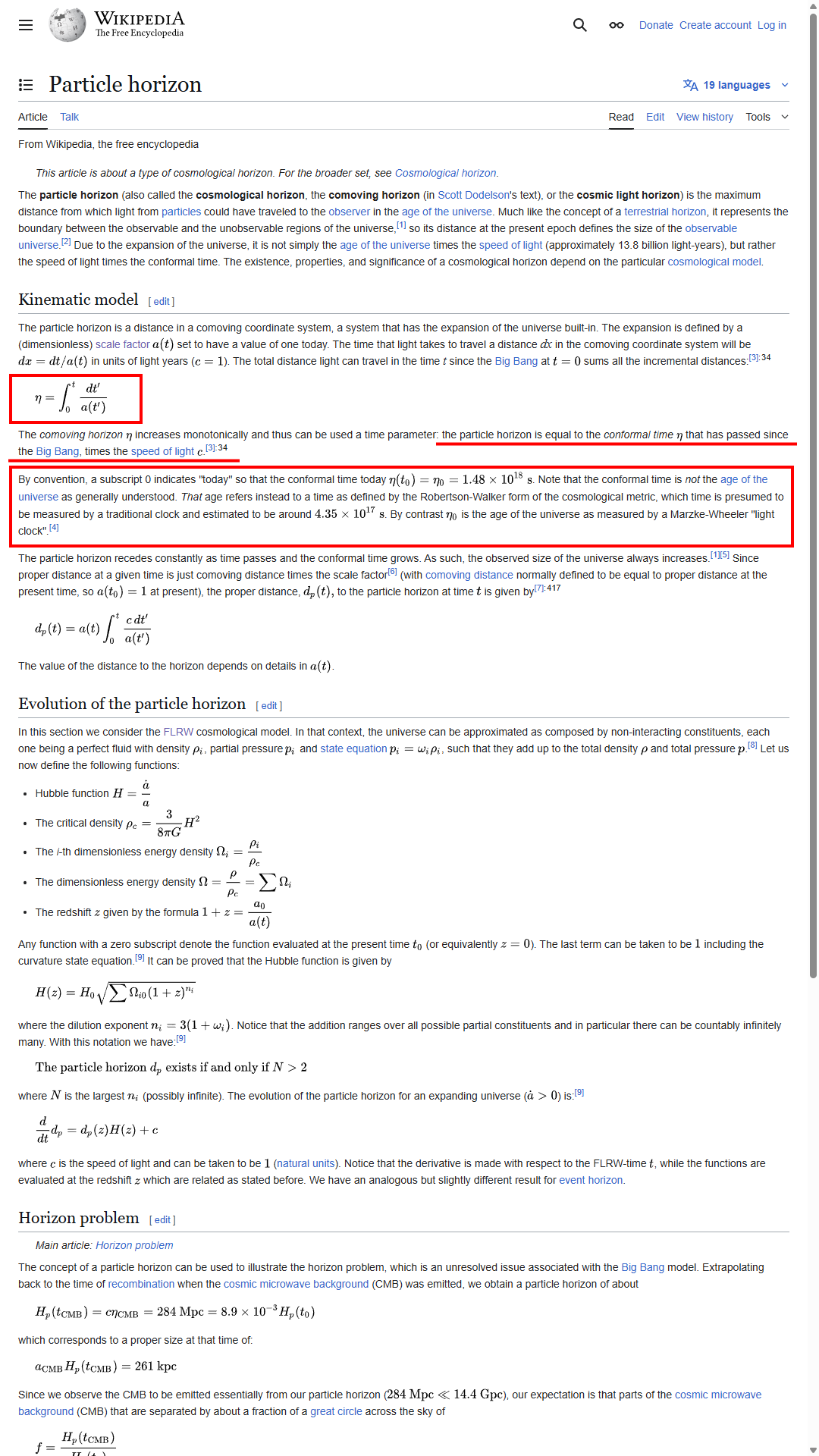
3 points3 points2 pointsI had a cat scan of my abdomen this week because recent blood test showed higher than normal liver enzymes. Today I got a call from the doctor telling me everything is normal, except that my colon seemed 'full.' What he didn't know is that I really like bulky foods like vegetables, bread, beans, etc, etc. So-- he asked me if I wanted him to prescribe something for constipation. After a good laugh I explained my eating habits and that. with all the fiber I eat, I had no problem whatsoever with constipation. I felt really good about the good news in the phone call-- then realized that this was the first time in my life that a doctor called me to tell me I was full of ____.2 points2 pointsNobody has any love for Maduro, but that is not the way the US used to do things. This just legitimizes the "rule of force" preferred by tyrants and dictators. Trump's America is now no better than Putin's Russia in Ukraine, or Xi's China would be if they take Taiwan. This is not how democracies act. And they certainly don't control, and profit, from the natural resources of the decapitated country. As for the drug trafficking, the US is the consumer. Going after one country that supplies will only shift the source to another supplier, unless you control the demand. That is how we control fossil fuel consumption, and for other vices, like prostitution, the 'John' is targeted to reduce demand Why is drug use the only vice where the consumer is the victim and the supplier the bad guy ?2 points2 pointsTo paraphrase you, regular chocolate and American chocolate are not the same thing either.. ;)2 pointshttps://en.wikipedia.org/wiki/Particle_horizon And now I think I really need to read about Marzke-Wheeler "light clock". Marzke, R. F.; Wheeler, J. A. (1964). Chiu, H. Y. (ed.). Gravitation and relativity. Benjamin. pp. 40–64.
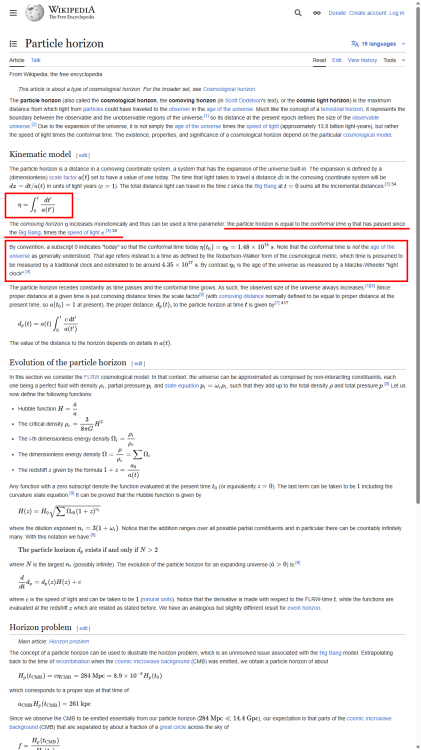 2 pointsUnbelievable. If the universe age equal to 13.8 billion years is already in the conformal time, then I can die happily. Thank you @Mordred2 points2 points2 pointsHi. It was almost a year ago, but I think I owe you the result of this test. And the answer is,2 points
new perpetual motion machine , coppyrighted , with proof , and renewable energy tech , please read .
2 pointsIt’s a version of the 2nd law of thermodynamics; you would be spontaneously heating an object with a cooler object. i.e. focusing sunlight will never get you above ~6000K2 pointsnew perpetual motion machine , coppyrighted , with proof , and renewable energy tech , please read .
2 pointsYes, I enjoy analysing "perpetual motion" machines. I actually came across one which I could not debunk without invoking a principle that I was not previously aware of. The principle I invoked was that a focused image of an object cannot be brighter than the object itself.2 points2 pointsThen go get a blog and post it there. This is a discussion forum; we’re interested in what people have to say about science and related topics. LLMs don’t “make points.” They regurgitate plausible-sounding dialog based on their training.2 pointsYou should see/talk to someone who knows what they are doing; there are professionals who deal with this and “tips about being happy” is a rather simplistic (and wrong) summary of what mental health professionals do. By phrasing it this way you are soliciting medical advice, and nobody here is qualified to dispense it.2 points2 points2 pointsFrom: https://bigthink.com/starts-with-a-bang/10-scientific-truths-unpopular-2025/ (December 9, 2025) Scientific truths remain true regardless of belief. These 10, despite contrary claims, remain vitally important as 2025 draws to a close. 1.) 2024, the latest full year on record, saw the highest CO2 levels and the highest average temperatures since we first began tracking them. 2.) Interstellar interlopers are real, and while we found a new one (only the third ever) in 2025, they are still not aliens. 3.) We broke the record for most distant galaxy ever found but still haven’t spotted the first generation of stars. 4.) Earth’s orbit has a finite “carrying capacity,” and if we exceed that, such as with megaconstellations of satellites, it will inevitably lead to Kessler syndrome. 5.) The germ theory of disease is real, and vaccination is the safest, most effective strategy to combat these deadly pathogens. 6.) SARS-CoV-2 led to COVID-19 in humans as the result of a natural, zoonotic spillover event, not as the result of a leaked pathogen from a Wuhan Lab in China. 7.) The Universe’s expansion is still accelerating, the Hubble tension remains an important puzzle, and the much-publicized evidence we have is insufficient to conclude that dark energy is evolving. 8.) “Passing peer review” doesn’t make a scientific study true; it just means the study is robust enough that it’s passed the “start line” for consideration by the community. 9.) We’ve found evidence for organics on Mars (again), but still have no good evidence for life on any planet other than Earth. 10.) You still need to know science in order to do it; “vibe science” is nothing more than AI slop. See https://bigthink.com/starts-with-a-bang/10-scientific-truths-unpopular-2025/ for details on each of the 10 scientific truths that somehow became unpopular in 2025.2 pointsBrilliant. But wonder what chilling Rhine water will do to riparian and deep water ecosystems. Many flora/fauna are temperature sensitive. They being Germans, I have some hope they worked this out, maybe the volume of water used and chilled isn't enough to make a significant difference. ETA: it looks like the fraction is tiny. Rhine flow rate gets up to over a million liters/sec along the Upper Rhine where Mannheim sits. And near three million at the Nordsee. (BTW, do not trust Google AI on river flow rates - go directly to technical sources)1 pointAI does not actually lie, but neither does it tell the truth. We tend to associate intelligence with being smart, honest, truthful, etc., but it is not. Measured intelligence is simply a speed test in something's/someone's ability to assimilate information. So AI (artificial intelligence) is all about statistics and has nothing to do with smart, honest, or truthful. Courts, on the other hand, are all about truth, so what happens when you mix these two ideas -- intelligence and truth? Consider that forty or so years ago, the State of Michigan (USA) was all about trying to convince it's people to use seat belts, so there were signs everywhere stating, "Seat Belts Save Lives". It was on commercials on television, on radio, on billboard signs, everywhere -- then it stopped. I was surprised that the campaign stopped until I learned that the Michigan Supreme Court heard a case regarding seat belts and concluded that they did not in truth save lives and sometimes they killed people. In light of this new information, I expected the seat belt law to be retracted -- it was not. We still have to wear seatbelts. What I did not know, but learned later, was that seatbelts do not save lives, but they do save money. As far as injuries go, it progresses from minor injury, to major injury, to death, but as far as expense goes, it progresses from minor injury, to death, to major injury. Apparently a major injury is much more expensive than a death, and seatbelts prevent major injury -- wearing a seatbelt will protect you from major injury, or it will kill you. Much less expensive -- truth. Something to think about. Gee1 point1 pointIf you're planning to be naked, probably best to choose the Amazon rather than Alaska. Heh.1 point1 pointModerator NoteThere is so much misinformation including claims of violating basic thermodynamics (https://en.wikipedia.org/wiki/Water_fuel_cell). Fundamentally, this post appears an attempt to spread disinformation, especially with regard to vaccinations, thus endangering public health. Don't bring this up again.1 point1 pointThere are also stories about the person who eventually thwarted the shooter. The reports are that the fake stories cropped up, fueled by AI/bots and spread on dodgy news sites and places that amplify such disinformation via their algorithms (X/Twitter and Facebook, to name two). Such bots do appear on Bluesky, but there’s no algorithm to amplify the slop. One of the effects here is to make all information untrustworthy. Stick with sources that actually do fact-checking and take the other stuff with a huge grain of salt.1 point1 pointYet under a tree an apple did fall, A genius left to wonder & mull.1 point1 pointBy all reports Nye still sports bow ties, Even during a marriage not wise Like a raging Godzilla Blair dowsed his garden with weed killah And hacked his emails with unflattering lies. https://www.bostonherald.com/2007/11/21/bad-chemistry-for-ex-lockhart-lover/1 point1 pointNow my favorite nerdy scientist: A physicist expert, Kaku, Said, "Parallel worlds might be true." With theories of strings, And the future of things, He broadens our cosmic view.1 pointYou have no idea, until you see the black dog prowl; I thought it would be easier, than waking up tomorrow, the only consideration in my attempt was pain, I dreamed of going to sleep, then nothing. It's no more a measure of courage, than it's a measure of cowardice, it's a measure of pain both physical and mental. Some of the lucky one's get a choice and fail, the unlucky one's don't get that choice. There is such a thing as hell on earth.1 pointCourage is acting in the face of some adversity, contrary to ones usual behaviour because it may overcome a personal problem or aid another that is in distress.1 point1 pointThere once was a fellow called Hooke I once read about in a book He pulled on a spring and noticed the thing grew longer, if one takes a look.1 point1 pointNot Hyperbole. My niece, Alex, is a magician at the Greg Frewin Theater in nearby Niagara Falls. Last year she made two appearances on Britain's Got Talent The theater used to keep tigers and when one tiger abandoned its newborn because of a broken leg , she nursed it back to health at home ( until it started looking at her like food ) and it is now in a zoo north of Toronto.1 point1 pointBut have you learned that if you put strips of tape on the floor in a rectangular/square pattern, your feline companion will happily lie down within the perimeter of the tape, as if it was a 'box' ? Or even on a rectangular sheet of paper/magazine you might leave on the floor ? ( yes, I had two cats for about 17 years, and my niece had a baby tiger for almost a year when she lived at my other house )1 pointSince this wavelength has changed over time, which one are you choosing? In what way is this age conformal?1 point1 point1 pointThat IS interesting. I knew it was standard in the smaller and domestic species (leave a new empty box sitting anywhere in our house and there will be a member of Felidae there within five minutes), but hadn't thought about the big cats. Leave a refrigerator box out on the savannah, see what happens...😀 TIL the origin of "bellwether." A wether is a castrated sheep. Put a bell around the neck of the lead wether and you can hear where the herd is going even if they're out of your line of sight.1 point1 pointYeah, there is a lot of slop, when you have five types of RS, and then also half a dozen types of soluble fiber and insoluble fiber all interacting with the gut colony in various ways. I recently was aware of some friends who were swearing off FODMAPs, as if that was a longterm diet, and I had to warn them that a lot of FODMAP foods are really good for you and you curtail them only temporarily (working with a physician ) to get relief from serious IBS symptoms. After that, the strategy is to work with probiotics and prebiotics and mechanical roughage and vitamins, etc to normalize your intestinal colony and redevelop a tolerance for FODMAPs. I used to work with a food chemist and nutritionist who related an experience treating gut problems in an Alaskan population and finding that vitamin D supplements wrought improvements in people who weren't eating fatty fishes and so were especially deficient (Alaska not being big on sunshine) in a vitamin now linked to a healthy gut microbiome. That's just one example of another component in the complexity of gut health and where they're only beginning to understand the molecular signaling pathways with vitamin D, the gut barrier, microbiota, and the development of IBD. (Nigerians: you probably have less need to worry about vitamin D...)1 point1 pointIn Canada we have inconsistent bans. Some pesticides/herbicides ( like concentrated RoundUp ) are banned for sale in one province, but legal to buy in another. And while I regularly deal with Organophosphorus compounds which have acute effects, I am apprehensive of those with chronic effects ( Organophosphates in particular due to naturally low Cholinesterase levels ). Also, I don't particularly like Monsanto's business practices and ethics, so I tend to not trust them. Veritasium has an excellent feature on Monsanto's development of RoundUp resistant GMO seeds, and the legal 'traps' for farmers using them.1 point1 pointAnd yet a substantial percentage of the world's population gain much of their carbohydrate and most of their protein intake from them without undue GI distress. I wonder if FODMAP sensitivity arises in part due to the typically impoverished diet of Western industrialised nations. Where of course, most of the limited research in the area will have been done, with all the consequent selection bias that implies.1 point1 pointIt might be a consequence of morphological changes due to things like hormonal changes, and the rest of the face getting smaller around it. It could be a non-functional byproduct of other processes. That's one hypothesis I've read about.1 point1 pointAs we are the only 'thinking' animal, it serves the convenient purpose of giving us a body part to 'cup' with our hand as we sit and think. I believe there is a statue illustrating this ...1 point1 pointAlthough not today, I recently learned a very surprising bit of trivia...human are the only animals that have that protruding bit of bone and flesh we call a chin--and there's no agreement in science on why that is. Furtherstill, niether our primates cousins nor our hominds ancestors have or have had chins.1 point1 pointA sentence that describes so much. That would make a good signature I think.1 point1 pointGreen banana and cooled tatos are a tonic To our microbial friends colonic; Like Ruminococcus bromii, It's fatty acids show me why, Starch resistance is not mere histrionic.1 pointSince you mention biology, you might be interested in a water pump and/or solenoid valve for turning on watering. You can also combine this with a water moisture detection module so that your Arduino project waters the plants on its own. Soldering , preheater, hot air gun, all with temperature control in one piece: Cost $250 (preheater small size, so not good for mobos except mobile)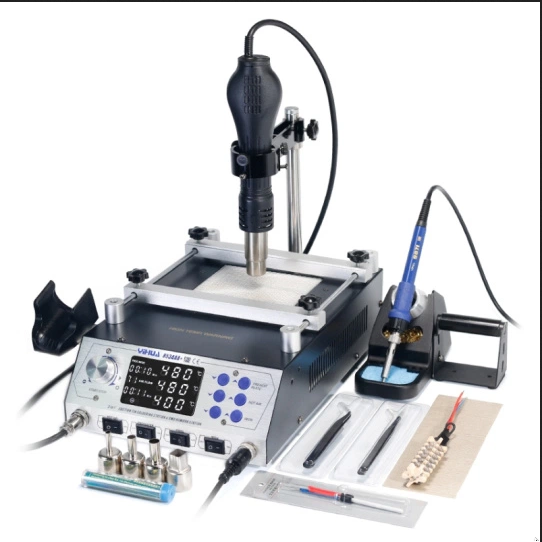 1 pointAnd the Jolly Roger is hoisted at last. 🏴☠️1 pointAn electronics technician needs: a multimeter, a soldering iron (preferably with adjustable temperature, but these are more expensive), a solder sucker, a set of screwdrivers of various types, miniature tweezers (such as those used for plucking nose hair), and an antistatic mat may also be useful. If you intend to repair phones, there are special mats with designated places to put screws, which will prevent them from getting lost. e.g.: Their prices are so low that if I were you, I would immediately order one for repairing phones and one normal large one. A cell phone repair kit would also be useful—they are very cheap. Around $5 for Android and $5 for iPhone. If you also have a 3D printer or a more expensive soldering iron with a built-in hot tip, then you have everything you need to repair a damaged phone screen. (The filament 3D printer has an adjustable printing surface temperature. https://en.wikipedia.org/wiki/Fused_filament_fabrication The cheapest FFF/FDM 3d printer from Creality Ender-3 costs 250-300 USD) That's probably everything that's cheap and for everyone. More expensive items include adjustable power supplies, both voltage and current, which prevent exceeding the range. These devices can be purchased for between $50 and $200. Even more expensive items include microscopes for electronics engineers (although there are some imitation models available for less than $25—I have one, and it works fine, but it is slow rate at 640x480). An IR camera is very useful for checking which component is heating up the most, i.e., is likely to be damaged because unlimited current and/or excessive voltage is flowing through The cheapest IR cameras cost around $300-400 and connect to cell phones via USB. I've seen some junk for less than $100, but they have a resolution of around 32 pixels or something like that, so it's better to go for higher resolution. An oscilloscope is a useful but expensive tool. $100-$500. However, it can be simulated using Arduino and a voltage divider and/or an opto element that will buffer between the circuit and Arduino. An oscilloscope will allow you to see what current and/or voltage is flowing through a given circuit over time. This way, you can find out whether the computer is booting and at which stage it fails. More expensive laboratory power supplies have their own current/voltage consumption graph on a time chart. The repair procedure for any electronic device is as follows: connect a laboratory power supply to the device, point an IR camera at it, and start increasing the voltage and current from 0V/0A (remember to zero it prior connecting!), watching which components heat up. You reach the voltage that it gets from the power supply at the factory (search the net/read etiquette). You see if it draws current, and you adjust it along with the voltage. If it's a simple fault, the damaged component usually lights up on the IR camera. Then you start analyzing whether it exceeds its parameters and why this may be happening. A typical component that breaks down is an electrolytic capacitor that has worn out and whose parameters have changed, causing it to no longer meet the basic design specifications. Sometimes you can even see which components have burned out and literally exploded. This often happens with capacitors, for example, and sometimes with resistors and chips (they then have a hole in their casing). If the CPU or another chip is damaged, you will still have a problem finding a replacement. Often, you have to buy other devices, the same model, and transplant them, cannibalize them. Chips can be non-programmable or programmable. To repair a programmable chip, you not only have to re-solder it, but also copy and extract data from the old broken one. Various readers are used for this purpose. That's a different story and a different level of difficulty. To properly replace such a chip or CPU on a computer or laptop motherboard, a so-called preheater is useful. If you intend to solder a lot of cables, you may also consider purchasing a soldering pot. Their prices vary depending on their tin capacity and power. If you don't intend to repair but design electronic circuits, you will need breadboards and cables for them (male-male, male-female, and female-female), as well as quick connectors for breadboards. Cheap. $5 for a large breadboard. A set of cables for them probably costs $5-10. Arduino is a must-have. Raspberry Pi optional. You don't need starter-kit - it is a waste of money. You don't need original - clone is good and cheap too. $10 for Arduino-clone is fine price. I hope this is enough to get you started on your adventure with repairing and/or building electronics. Your wallet is your limit.. ;)
 1 pointThat list would ne very wide and very expensive I suggest trying to narrow it down a bit. You could try to get hold of The Book of Experiments The Second Book of Experiments By De Vries I particularly like the list of equipment in one experiment You will require I thunderstorm. ... More modern books with good experiments From Calculus to Chaos - Acheson The Mathematical Mechanic - Levi1 pointWhat do you mean by a larger mechanical output? How is that achieved without violating energy conservation?1 pointSome more ancient implementation of these principles are The ballista The slingshot ballista The Atlatl Anthropologists now believe tha last of these was partly responsible for the eventual ascendency of homo sapiens over other human species.1 pointHmm, this reads like an extract from a patent application. I rather think however it may have been anticipated, in terms of novelty, by this: (You can expect a Patent Office Examiner with a sense of humour to cite this as prior art.😁) Nevertheless I look forward to your description of how the cocked device performs mechanical work, and in particular to how generation of torque is achieved. P.S. The amount of work it can do is obviously equal (ignoring any losses) to the weight of the counterweight multiplied by the vertical distance it drops when pulling the device over from vertical to horizontal.1 pointWell I haven't watched your video, but congratulations on a novel version of a well used mechanical principle, +1 I look forward to the rest of your presentation here to complete your post#2 I am not sure the ancients used anything like this to lift heavy blocks, there is a simpler way without the dificulties of making a strong enough lever. Have you heard of folding wedges or using rotation to slowly lift a block by easing up one corner at a time ? Meanwhile here are a couple of modern applications of combining levers and rotation (Tower bridge has been in operation for well over a century now) Bascule bridge. Wikipedia has some great animations https://en.wikipedia.org/wiki/Bascule_bridge Falkirk Wheel https://en.wikipedia.org/wiki/Falkirk_Wheel1 pointThe equations of general relativity possess time-reversal symmetry, as do the general solutions of those equations, taken as sets of all solutions for each of the equations. But the individual solutions taken from a set of all solutions, perhaps specific solutions resulting from specifying auxiliary conditions, often do not share the symmetries of the equation, such as time-reversal symmetry. In other words, applying a symmetry transformation often transforms one solution to a different solution, not the same solution. It is my understanding that for a wave equation, the initial conditions contain all the information required for the retarded wave solution, rendering the advanced wave solution redundant. Also, the retarded wave solution is an expanding wave solution in the future direction while the advanced wave solution is an expanding wave solution in the past direction. But an expanding wave solution in the past direction is a contracting wave solution in the future direction and would require carefully arranged emitters to produce such a solution, noting that reality possesses an arrow of time which enforces the notion of causality and the second law of thermodynamics. This does not violate general relativity as covariance is maintained in spite of the asymmetry implied by the arrow of time. I suppose the simplest way to explain this is that the existence of symmetry in the laws of physics does not imply the absence of asymmetry in the laws of physics.1 pointI must admit this rings alarm bells with me. Especially the “Ancient Secrets” shtick. Basically work done is force x distance moved in the direction of the force. So sure a 0.23oz force can move heavy object, but only by as much as Fxd allows. In the case you mention, you don’t say anything about how the 10.5oz sled is moved. Is it on rollers, or sliding, on what surface, is it horizontal or on an incline, and so on. Can you describe it? (Videos are not acceptable here, by the way, so you need to describe in words the setup, with the aid of a diagram if necessary.)1 point









Important Information
We have placed cookies on your device to help make this website better. You can adjust your cookie settings, otherwise we'll assume you're okay to continue.
Account
Search
Configure browser push notifications
Chrome (Android)
- Tap the lock icon next to the address bar.
- Tap Permissions → Notifications.
- Adjust your preference.
Chrome (Desktop)
- Click the padlock icon in the address bar.
- Select Site settings.
- Find Notifications and adjust your preference.
Safari (iOS 16.4+)
- Ensure the site is installed via Add to Home Screen.
- Open Settings App → Notifications.
- Find your app name and adjust your preference.
Safari (macOS)
- Go to Safari → Preferences.
- Click the Websites tab.
- Select Notifications in the sidebar.
- Find this website and adjust your preference.
Edge (Android)
- Tap the lock icon next to the address bar.
- Tap Permissions.
- Find Notifications and adjust your preference.
Edge (Desktop)
- Click the padlock icon in the address bar.
- Click Permissions for this site.
- Find Notifications and adjust your preference.
Firefox (Android)
- Go to Settings → Site permissions.
- Tap Notifications.
- Find this site in the list and adjust your preference.
Firefox (Desktop)
- Open Firefox Settings.
- Search for Notifications.
- Find this site in the list and adjust your preference.