Avatar

robertskmiles

@robertskmiles / robertskmiles.tumblr.com

I'm Rob Miles. My main blog is life-in-a-monospace-typeface. This is a sideblog, for conversation and lower-effort content
Avatar
samsaranmusing-deactivated20140

Orbital path of asteroid near miss in 2002. Yah, that’s how close we came to nuclear winter and possible total destruction.

Avatar
lonelyinsomniac

A visitor.

Avatar
scary-monsters-and-davesprite

It’s like it’s trying so hard to hit us and it just can’t do it

All I can imagine is every astronomer drinking heavily from 2002-2003 like “There it goes–OH FUCK IT’S COMING BACK”

Thanks moon <3

Avatar
perkachow

Moon: YEET

Avatar
squirtlesquad-rebellion

The moon threw it away yay moon

Avatar
snarcadegannon

the moon was having none  of it

Avatar
cpt-langosta

The best part about this? They took a picture (read: spectrographic analysis) of the thing and found out it wasn’t an asteroid at all. It was a piece of a Saturn V rocket, discarded in space decades ago and set into an orbit around the sun. That’s right, this motherfucker spent 30 years orbiting the sun, waiting for a chance to have its revenge on the petty humans who abandoned it in the void.

So that weirdly common Star Trek trope in which one of our space probes comes back to fuck us up turned out to be true

Am I right in thinking this thing wouldn't have survived re-entry and so isn't any kind of threat?

Avatar
Reblogged
Annual maintenance costs for steam locomotives accounted for 25% of the initial purchase price. Spare parts were cast from wooden masters for specific locomotives. The sheer number of unique steam locomotives meant that there was no feasible way for spare-part inventories to be maintained.

emphasis added

I always thought it was interesting that in the 'Civilisation' tech tree, 'Replaceable Parts' is its own whole technology that needs to be invented, and that it has both Steam Power and Electricity as prerequisite technologies. But I guess that's how it was.

(http://civilization.wikia.com/wiki/Replaceable_Parts_(Civ5))[http://civilization.wikia.com/wiki/Replaceable_Parts_(Civ5)]

Avatar
Reblogged

The fuck is up with the South Bay

In Northern England I could get a large Dominoes pizza for 5 quid

Here a large Dominoes pizza is over 20 dollars (tax-inclusive, because the British price would be tax-inclusive)

Like, this was post-Brexit. It wasn’t because the pound was worth something. It was literally the cost of a Dominoes pizza in England being barely over a quarter of the cost here.

That is… Not the kind of cost of living difference you expect to happen? Like, four fold rent differences happen. The restaurants being fancier in one place than another happens. But the food products of the same franchise being four times more expensive in one location than another is just insane.

How? How how how?

a large dominoes pizza in the UK is closer to around £10-£20 where i’ve been (london, nottingham), i think north england is just particularly cheap or they maybe had a special offer?. although pizza from smaller chains/ non chain shops is often cheaper.

just going to the UK site now it ranges from £16-20 for a not on offer large (13.5 inch) pizza.

It's weird that you wrote almost exactly the comment I was going to write, including checking the prices on the website and living in London and Nottingham.

Avatar
Reblogged

Know the difference

Avatar
chokesngags

Wow.

What if your relationship is everything on all four charts except “weakened by separation”?

Avatar
evolution-is-just-a-theorem

Then you should tell the rest of the world what cheat codes you used.

I would tell if I knew. Be a nerd, date a nerd? Cuddle a lot? Don’t be afraid to tell your partner things and ask them for what you want? Definitely ask out anybody you want to date rather than being a chicken. 

I think in this as in other spheres of my life the best explanation I have is “I am very lucky and everything I attempt goes smoothly without any special knowledge/skill on my part”

"I am very lucky and everything I attempt goes smoothly without any special knowledge/skill on my part"

If I wore t-shirts, I would wear this on a t-shirt.

In Japan (and less commonly in China), there’s a concept of a 30-hour day.

Not in the sense that two days would be 60 hours, but more that the days overlap between midnight and 6 AM. So, for instance, it something happened 2 AM on Sunday, you could say “2 o’clock on Sunday”, but you could also say “26 o’clock on Saturday”.

Which MAKES SO MUCH SENSE. When you talk about things happening “last night”, it doesn’t suddenly stop being “last night” the instant the clock strikes midnight because I’m not Cinderella.

In conclusion, I wish America had this so I could throw it in the face of every smug friend who says “DON’T YOU MEAN LATER TODAY????” when I tell them “see you tomorrow” at two minutes past midnight.

Some more sources:

This is most common in TV schedules:

Anime aired from around 11 p.m. until the wee hours of the morning, occasionally indicated by the odd-looking “22:00-27:00” notation. […]
The trope name refers to the odd way of noting when the shows start airing; it’s common to see a show aired at 1:00 am listed at “25:00”. This is largely done to align the schedule with that of the previous day; many Japanese TV networks still sign off in the middle of the night, and those who don’t will only switch to “the next day”’s programming at 4 am or so.
Times past midnight can also be counted past the 24 hour mark, usually when the associated activity spans across midnight. For example, bars or clubs may advertise as being open until “26時” (i.e. 2 am). This is partly to avoid any ambiguity (2 am versus 2 pm), partly because the closing time is considered part of the previous business day, and perhaps also due to cultural perceptions that the hours of darkness are counted as part of the previous day, rather than dividing the night between one day and the next. Television stations will also frequently use this notation in their late-night scheduling. This form is rarely used in conversation.
cultural perceptions that the hours of darkness are counted as part of the previous day

idk about you, but I have the same cultural perceptions. Let’s get this popularized in the US!

In some cultures the day changes over when the Sun sets, in others when the Sun rises. Midnight is a pretty unintuitive convention, but I can see its value for some purposes.

But relaxing the requirement that 'every moment can only be referred to by a single time' is a very elegant solution, and very obvious in retrospect.

Avatar
Reblogged
Anonymous asked:

watch?v=ydqReeTV_vk

this made me cry, but in a good way

Avatar

I've always hated parody songs because I tend to pick up lyrics very quickly, so hearing different lyrics to a song I already know causes both sets to be stored 'on top of one another' in a way that makes it kind of mentally uncomfortable to hear or think about the song. So I have to avoid parodies of songs I like.

But now that I've stopped listening to the radio or generally keeping up with popular music, I don't know the originals of any of these parodies, so I can enjoy them. Now I just have to keep avoiding the originals.

Avatar
Reblogged
Avatar
beyonceprivilege-deactivated201

i’m doing all this research on when “like” is used as a filler vs. “um” or “uh” or whatever & i’m really loving this

basically my fav pattern so far is how these teen girls use “like” pretty exclusively when they’re sharing these concepts that are unknown to them or  just guess work, ya know? 

they’ll say “here’s the, um, living room” but then they’ll say “in this picture my brother is, like, howling or something” 

& i love it i mean i love the way they use “like” to express uncertainty and idk pensiveness? “um” expresses a break in a sentence, some disfluency. but “like” holds actual semantic meaning and is an indicator that expresses what follows isn’t gonna be totally accurate but just to the speaker’s best estimation.

i mean, he’s, like, howling or something, right? 

girl talk is cool talk 

No but we’re all like “wow, wouldn’t it be cool if there were a language with explicit markers for epistemic uncertainty? That would be the Most Rational Language” and hey would you look at that

here lies an alternate usage! “to be like” as a verb similar to “to say” which tbh has been my biggest problem in trying to use “like” less in conversation. 

“to be like” is such a useful verb, I’m so glad it’s in my vocabulary

And it needs to be said that "to be like" is importantly different from reported speech! It can be used just to relate what someone said, sure, but it's much more versatile. For instance, it can relate internal speech or thought. Consider "He just stared at me like 'what is this guy doing here?'". That is super clumsy without 'like'. What have you got? "He just stared at me as if he was wondering what I was doing there"? And that doesn't capture the shades of meaning you can put into the phrasing and delivery of the reported speech/thought. Because "he was like" does not mean "he said", it means "here follows a short impression of him at that moment", and that impression can be reported speech, reported thought, a non-verbal noise, a gesture, a facial expression... it's extremely versatile and honestly I'm not sure how we ever managed to communicate clearly without it.

Non-rhetorical question, did English used to have other ways to smoothly embed quick impressions into speech?

Avatar
Reblogged

There was a whole lot of goofy stuff in the Donnie Darko Director’s Cut and the voice commentary track for it, because Richard Kelly apparently planned a whole lot of sci-fi comic book logic “explaining” why everything happened, and (fortuitously!) had to leave it out of the original cut

Anyway, the one thing that sums this up best, for me, is that in the Director’s Cut commentary for that scene where Drew Barrymore’s edgy English teacher character says “sit next to the boy you think is the cutest,” Kelly clarifies that she didn’t say this because it’s the sort of thing the character would say (even though it is), but because a transhuman AI god from the future manipulated her mind so as to encourage the budding attraction between Donnie and Jena Malone’s character, since they both had important roles to play in its cosmic plan

...and when Donnie Darko went on to be hugely successful, the director got much more latitude on his next project, and we got Southland Tales. That explains some things.

Avatar
Reblogged

I’ll put the people happy about the PewDiePie copyright strike on blast: This is terrible precedent, and you should know it.

Forget for a moment the issue of “giant corporations like Google deciding who can speak and how”. Let’s table that.

This is JUST about the copyright strike. We also will leave aside PewDiePie’s racist incidents. Why? Because the copyright strike does not depend on them. It is independent of anything PewDiePie did, EXCEPT for post videos of himself playing the game.

The precedent from this strike is thus: Any dev can, at any time, copyright strike any Let’s Player who’s ever played their game for an audience. The real moral here, if one supports the strike, is: Let’s Plays are illegitimate. (Streaming too, even if Twitch might not have the same type of copyright-policing apparatus… Yet.)

If this precedent were actually enforced, you can say goodbye to your Game Grumps, to all your favorite personalities on Twitch, etc. But it won’t be enforced, not in a real and consistent way.

It will be a different kind of bad. This issue is now bigger than just “megacorps like Google can shut you down on the biggest platforms”. No. This is even more insidious: As long as three fuckers with an axe to grind are willing to strike you, then you’re gone. Even if we think that Google should be the arbiter and decide who can speak (and I don’t), placing this control in so many hands is even worse. Imagine an internet where on any given platform, there were hundreds of people who could destroy you if they felt like it, and they all had different ideologies and preferences and things that offended them. Navigating that maze would be nigh-impossible. (And yes I realize I’ve just described social media, and why it’s hellish.)

“Ok, but that only applies to Let’s Players and streamers; this is overblown.”

Yes, this only applies to people who use bits of copyrighted works in their content… Even if it were ONLY the destruction of people who play games for an audience, I would mourn it. But imagine all the reviewers, all the people Seriously Talking About Games. This precedent could easily stretch to them. (Or to people criticizing movies, TV etc.) And in fact we know that Content ID is already used to chill media criticism. We should not cheer the empowerment of these tools.

If you say “this strike is fine because PewDiePie is a racist”, then you’re fucking unprincipled. Say “this strike is fine because Let’s Players are illegitimate and should be shut down at the will of game devs, or better yet altogether”.

I hope no one ever streams Campo Santo’s games again.

finally, no more video games!

My position on this stuff was always

I do not care about PewDiePie I will not care about PewDiePie You cannot make me care about PewDiePie

But it turns out all it took was setting a dangerous legal precedent that could cripple any online media criticism.

I think anti-price-gouging sentiment actually sometimes comes from a place of privilege: it comes from people for the first time seriously considering a scenario in which they desperately need something but can't afford to pay the market price for it. In their minds, not being able to afford things is for things you want, not things you need, because they and everyone they know have always had enough money to buy what they need. So in a disaster when things become scarce and there isn't enough to go around, and the market price goes up to reflect that there's not enough for everyone, the thinking is "how can the seller be so evil as to look at someone who desperately needs basic things like food, and refuse to sell it to them for a price they can afford?", when like, that's always been how the system works, that is daily life for millions of people. But now the price has gone up to the point you you can imagine yourself not being able to afford what you need, only now it's a terrible thing that needs to be someone's fault.

When there's something people want but there's not enough for everyone, the rich are the ones who get it. That's the system we've got, and its fairness or unfairness doesn't change when prices go up and you stop counting as one of the rich.

Avatar
silvercistern-deactivated202307

so apparently some people feel like it’s annoying when someone engages with a lot of stuff from the same person, like going through their ship tag and liking all the content there. 

hearing about this, i was immediately paranoid about reblogging literally anything from anyone i don’t talk to on a regular basis.

so to save others from the same paranoia, i’m gonna say that if you like every single post on my goddamn blog it is okay. i might be kind of concerned about your level of time management, going through 23,000 posts, but it wouldn’t bother me. 

Avatar
Reblogged

He’s engraved in stone in the National World War II Memorial in Washington, DC – back in a small alcove where very few people have seen it. For the WWII generation, this will bring back memories. For younger folks, it’s a bit of trivia that is an intrinsic part of American history and legend.

Anyone born between 1913 to about 1950, is very familiar with Kilroy. No one knew why he was so well known….but everybody seemed to get into it. It was the fad of its time!

          At the National World War II Memorial in Washington, DC

So who was Kilroy?

In 1946 the American Transit Association, through its radio program, “Speak to America,” sponsored a nationwide contest to find the real Kilroy….now a larger-than-life legend of just-ended World War II….offering a prize of a real trolley car to the person who could prove himself to be the genuine article.

Almost 40 men stepped forward to make that claim, but only James Kilroy from Halifax, Massachusetts, had credible and verifiable evidence of his identity.

“Kilroy” was a 46-year old shipyard worker during World War II (1941-1945) who worked as a quality assurance checker at the Fore River Shipyard in Quincy, Massachusetts (a major shipbuilder for the United States Navy for a century until the 1980s).  

His job was to go around and check on the number of rivets completed. (Rivets held ships together before the advent of modern welding techniques.) Riveters were on piece work wages….so they got paid by the rivet. He would count a block of rivets and put a check mark in semi-waxed lumber chalk (similar to crayon), so the rivets wouldn’t be counted more than once.

                                     A warship hull with rivets

When Kilroy went off duty, the riveters would surreptitiously erase the mark. Later, an off-shift inspector would come through and count the rivets a second time, resulting in double pay for the riveters!

One day Kilroy’s boss called him into his office. The foreman was upset about unusually high wages being “earned” by riveters, and asked him to investigate. It was then he realized what had been going on. 

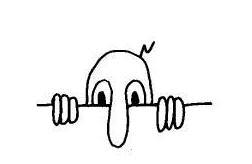
The tight spaces he had to crawl in to check the rivets didn’t lend themselves to lugging around a paint can and brush, so Kilroy decided to stick with the waxy chalk. He continued to put his check mark on each job he inspected, but added KILROY WAS HERE! in king-sized letters next to the check….and eventually added the sketch of the guy with the long nose peering over the fence….and that became part of the Kilroy message.

   Kilroy’s original shipyard inspection “trademark” during World War II

Once he did that, the riveters stopped trying to wipe away his marks.

Ordinarily the rivets and chalk marks would have been covered up with paint. With World War II on in full swing, however, ships were leaving the Quincy Yard so fast that there wasn’t time to paint them. As a result, Kilroy’s inspection “trademark” was seen by thousands of servicemen who boarded the troopships the yard produced.

His message apparently rang a bell with the servicemen, because they picked it up and spread it all over the European and the Pacific war zones.

Before war’s end, “Kilroy” had been here, there, and everywhere on the long hauls to Berlin and Tokyo. 

To the troops outbound in those ships, however, he was a complete mystery; all they knew for sure was that someone named Kilroy had “been there first.” As a joke, U.S. servicemen began placing the graffiti wherever they landed, claiming it was already there when they arrived.

As the World War II wore on, the legend grew. Underwater demolition teams routinely sneaked ashore on Japanese-held islands in the Pacific to map the terrain for coming invasions by U.S. troops (and thus, presumably, were the first GI’s there). On one occasion, however, they reported seeing enemy troops painting over the Kilroy logo!

Kilroy became the U.S. super-GI who had always “already been” wherever GIs went. It became a challenge to place the logo in the most unlikely places imaginable. (It is said to now be atop Mt. Everest, the Statue of Liberty, the underside of the Arc de Triomphe in Paris, and even scrawled in the dust on the moon by the American astronauts who walked there between 1969 and 1972.

In 1945, as World War II was ending, an outhouse was built for the exclusive use of Allied leaders Harry Truman, Joseph Stalin, and Winston Churchill at the Potsdam Conference. It’s first occupant was Stalin, who emerged and asked his aide (in Russian), “Who is Kilroy?”

To help prove his authenticity in 1946, James Kilroy brought along officials from the shipyard and some of the riveters. He won the trolley car….which he attached to the Kilroy home and used to provide living quarters for six of the family’s nine children….thereby solving what had become an acute housing crisis for the Kilroys.

                     The new addition to the Kilroy family home.

                                        *          *          *          *

And the tradition continues into the 21st century…

In 2011 outside the now-late-Osama Bin Laden’s hideaway house in Abbottabad, Pakistan….shortly after the al-Qaida-terrorist was killed by U.S. Navy SEALs

>>Note: The Kilroy graffiti on the southwest wall of the Bin Laden compound pictured above was real (not digitally altered with Microsoft Paint, as postulated by some). The entire compound was leveled in 2012 for redevelopment by a Pakistani company as an amusement park….and to avoid it becoming a shrine to Bin Laden’s nefarious memory.

                                         *          *          *          *

A personal note….

My Dad’s trademark signature on cards, letters and notes to my sisters and I for the first 50 or so years of our lives (until we lost him to cancer) was to add the image of “Kilroy” at the end. We kids never ceased to get a thrill out of this….even as we evolved into adulthood. 

To this day, the “Kilroy” image brings back a vivid image of my awesome Dad into my head….and my heart!

Dad: This one’s for you!

image

OMG I’m so glad to know this backstory.

I heard Kilroy had the first Tumblr account!

When I was a kid, we used to watch these TV shows in school to help us with reading and spelling, you know the drill. One of these was set in World War Two, and had this little animated character who popped up to show us how to spell. He was called ‘The Chad’, but seeing this I realise he was styled after Kilroy. TL:DR loads of little English kids in the 90s were drawing this too because we’d seen him in our spelling videos.

@robertskmiles omg I remember the tune too! Something like “the Chad is on the case, trying to check it out…” I think it was one of the Magic Pencil series, and had the evacuees thinking they’d found secret Nazis in rural Berkshire or something, but it was actually a black market ring.

Yes! This gave me the information I needed to find this:

You were bloody close with those lyrics, but he's not on the case he's on the snoop, which must be where I got 'The Snoop' as his name.

Avatar
Reblogged

He’s engraved in stone in the National World War II Memorial in Washington, DC – back in a small alcove where very few people have seen it. For the WWII generation, this will bring back memories. For younger folks, it’s a bit of trivia that is an intrinsic part of American history and legend.

Anyone born between 1913 to about 1950, is very familiar with Kilroy. No one knew why he was so well known….but everybody seemed to get into it. It was the fad of its time!

          At the National World War II Memorial in Washington, DC

So who was Kilroy?

In 1946 the American Transit Association, through its radio program, “Speak to America,” sponsored a nationwide contest to find the real Kilroy….now a larger-than-life legend of just-ended World War II….offering a prize of a real trolley car to the person who could prove himself to be the genuine article.

Almost 40 men stepped forward to make that claim, but only James Kilroy from Halifax, Massachusetts, had credible and verifiable evidence of his identity.

“Kilroy” was a 46-year old shipyard worker during World War II (1941-1945) who worked as a quality assurance checker at the Fore River Shipyard in Quincy, Massachusetts (a major shipbuilder for the United States Navy for a century until the 1980s).  

His job was to go around and check on the number of rivets completed. (Rivets held ships together before the advent of modern welding techniques.) Riveters were on piece work wages….so they got paid by the rivet. He would count a block of rivets and put a check mark in semi-waxed lumber chalk (similar to crayon), so the rivets wouldn’t be counted more than once.

                                     A warship hull with rivets

When Kilroy went off duty, the riveters would surreptitiously erase the mark. Later, an off-shift inspector would come through and count the rivets a second time, resulting in double pay for the riveters!

One day Kilroy’s boss called him into his office. The foreman was upset about unusually high wages being “earned” by riveters, and asked him to investigate. It was then he realized what had been going on. 

The tight spaces he had to crawl in to check the rivets didn’t lend themselves to lugging around a paint can and brush, so Kilroy decided to stick with the waxy chalk. He continued to put his check mark on each job he inspected, but added KILROY WAS HERE! in king-sized letters next to the check….and eventually added the sketch of the guy with the long nose peering over the fence….and that became part of the Kilroy message.

   Kilroy’s original shipyard inspection “trademark” during World War II

Once he did that, the riveters stopped trying to wipe away his marks.

Ordinarily the rivets and chalk marks would have been covered up with paint. With World War II on in full swing, however, ships were leaving the Quincy Yard so fast that there wasn’t time to paint them. As a result, Kilroy’s inspection “trademark” was seen by thousands of servicemen who boarded the troopships the yard produced.

His message apparently rang a bell with the servicemen, because they picked it up and spread it all over the European and the Pacific war zones.

Before war’s end, “Kilroy” had been here, there, and everywhere on the long hauls to Berlin and Tokyo. 

To the troops outbound in those ships, however, he was a complete mystery; all they knew for sure was that someone named Kilroy had “been there first.” As a joke, U.S. servicemen began placing the graffiti wherever they landed, claiming it was already there when they arrived.

As the World War II wore on, the legend grew. Underwater demolition teams routinely sneaked ashore on Japanese-held islands in the Pacific to map the terrain for coming invasions by U.S. troops (and thus, presumably, were the first GI’s there). On one occasion, however, they reported seeing enemy troops painting over the Kilroy logo!

Kilroy became the U.S. super-GI who had always “already been” wherever GIs went. It became a challenge to place the logo in the most unlikely places imaginable. (It is said to now be atop Mt. Everest, the Statue of Liberty, the underside of the Arc de Triomphe in Paris, and even scrawled in the dust on the moon by the American astronauts who walked there between 1969 and 1972.

In 1945, as World War II was ending, an outhouse was built for the exclusive use of Allied leaders Harry Truman, Joseph Stalin, and Winston Churchill at the Potsdam Conference. It’s first occupant was Stalin, who emerged and asked his aide (in Russian), “Who is Kilroy?”

To help prove his authenticity in 1946, James Kilroy brought along officials from the shipyard and some of the riveters. He won the trolley car….which he attached to the Kilroy home and used to provide living quarters for six of the family’s nine children….thereby solving what had become an acute housing crisis for the Kilroys.

                     The new addition to the Kilroy family home.

                                        *          *          *          *

And the tradition continues into the 21st century…

In 2011 outside the now-late-Osama Bin Laden’s hideaway house in Abbottabad, Pakistan….shortly after the al-Qaida-terrorist was killed by U.S. Navy SEALs

>>Note: The Kilroy graffiti on the southwest wall of the Bin Laden compound pictured above was real (not digitally altered with Microsoft Paint, as postulated by some). The entire compound was leveled in 2012 for redevelopment by a Pakistani company as an amusement park….and to avoid it becoming a shrine to Bin Laden’s nefarious memory.

                                         *          *          *          *

A personal note….

My Dad’s trademark signature on cards, letters and notes to my sisters and I for the first 50 or so years of our lives (until we lost him to cancer) was to add the image of “Kilroy” at the end. We kids never ceased to get a thrill out of this….even as we evolved into adulthood. 

To this day, the “Kilroy” image brings back a vivid image of my awesome Dad into my head….and my heart!

Dad: This one’s for you!

image

OMG I’m so glad to know this backstory.

I heard Kilroy had the first Tumblr account!

When I was a kid, we used to watch these TV shows in school to help us with reading and spelling, you know the drill. One of these was set in World War Two, and had this little animated character who popped up to show us how to spell. He was called ‘The Chad’, but seeing this I realise he was styled after Kilroy. TL:DR loads of little English kids in the 90s were drawing this too because we’d seen him in our spelling videos.

^This must be what I was talking about in this post!:

http://robertskmiles.tumblr.com/post/165224183065/naamahdarling-allthingslinguistic

He’s engraved in stone in the National World War II Memorial in Washington, DC – back in a small alcove where very few people have seen it. For the WWII generation, this will bring back memories. For younger folks, it’s a bit of trivia that is an intrinsic part of American history and legend.

Anyone born between 1913 to about 1950, is very familiar with Kilroy. No one knew why he was so well known….but everybody seemed to get into it. It was the fad of its time!

          At the National World War II Memorial in Washington, DC

So who was Kilroy?

In 1946 the American Transit Association, through its radio program, “Speak to America,” sponsored a nationwide contest to find the real Kilroy….now a larger-than-life legend of just-ended World War II….offering a prize of a real trolley car to the person who could prove himself to be the genuine article.

Almost 40 men stepped forward to make that claim, but only James Kilroy from Halifax, Massachusetts, had credible and verifiable evidence of his identity.

“Kilroy” was a 46-year old shipyard worker during World War II (1941-1945) who worked as a quality assurance checker at the Fore River Shipyard in Quincy, Massachusetts (a major shipbuilder for the United States Navy for a century until the 1980s).  

His job was to go around and check on the number of rivets completed. (Rivets held ships together before the advent of modern welding techniques.) Riveters were on piece work wages….so they got paid by the rivet. He would count a block of rivets and put a check mark in semi-waxed lumber chalk (similar to crayon), so the rivets wouldn’t be counted more than once.

                                     A warship hull with rivets

When Kilroy went off duty, the riveters would surreptitiously erase the mark. Later, an off-shift inspector would come through and count the rivets a second time, resulting in double pay for the riveters!

One day Kilroy’s boss called him into his office. The foreman was upset about unusually high wages being “earned” by riveters, and asked him to investigate. It was then he realized what had been going on. 

The tight spaces he had to crawl in to check the rivets didn’t lend themselves to lugging around a paint can and brush, so Kilroy decided to stick with the waxy chalk. He continued to put his check mark on each job he inspected, but added KILROY WAS HERE! in king-sized letters next to the check….and eventually added the sketch of the guy with the long nose peering over the fence….and that became part of the Kilroy message.

   Kilroy’s original shipyard inspection “trademark” during World War II

Once he did that, the riveters stopped trying to wipe away his marks.

Ordinarily the rivets and chalk marks would have been covered up with paint. With World War II on in full swing, however, ships were leaving the Quincy Yard so fast that there wasn’t time to paint them. As a result, Kilroy’s inspection “trademark” was seen by thousands of servicemen who boarded the troopships the yard produced.

His message apparently rang a bell with the servicemen, because they picked it up and spread it all over the European and the Pacific war zones.

Before war’s end, “Kilroy” had been here, there, and everywhere on the long hauls to Berlin and Tokyo. 

To the troops outbound in those ships, however, he was a complete mystery; all they knew for sure was that someone named Kilroy had “been there first.” As a joke, U.S. servicemen began placing the graffiti wherever they landed, claiming it was already there when they arrived.

As the World War II wore on, the legend grew. Underwater demolition teams routinely sneaked ashore on Japanese-held islands in the Pacific to map the terrain for coming invasions by U.S. troops (and thus, presumably, were the first GI’s there). On one occasion, however, they reported seeing enemy troops painting over the Kilroy logo!

Kilroy became the U.S. super-GI who had always “already been” wherever GIs went. It became a challenge to place the logo in the most unlikely places imaginable. (It is said to now be atop Mt. Everest, the Statue of Liberty, the underside of the Arc de Triomphe in Paris, and even scrawled in the dust on the moon by the American astronauts who walked there between 1969 and 1972.

In 1945, as World War II was ending, an outhouse was built for the exclusive use of Allied leaders Harry Truman, Joseph Stalin, and Winston Churchill at the Potsdam Conference. It’s first occupant was Stalin, who emerged and asked his aide (in Russian), “Who is Kilroy?”

To help prove his authenticity in 1946, James Kilroy brought along officials from the shipyard and some of the riveters. He won the trolley car….which he attached to the Kilroy home and used to provide living quarters for six of the family’s nine children….thereby solving what had become an acute housing crisis for the Kilroys.

                     The new addition to the Kilroy family home.

                                        *          *          *          *

And the tradition continues into the 21st century…

In 2011 outside the now-late-Osama Bin Laden’s hideaway house in Abbottabad, Pakistan….shortly after the al-Qaida-terrorist was killed by U.S. Navy SEALs

>>Note: The Kilroy graffiti on the southwest wall of the Bin Laden compound pictured above was real (not digitally altered with Microsoft Paint, as postulated by some). The entire compound was leveled in 2012 for redevelopment by a Pakistani company as an amusement park….and to avoid it becoming a shrine to Bin Laden’s nefarious memory.

                                         *          *          *          *

A personal note….

My Dad’s trademark signature on cards, letters and notes to my sisters and I for the first 50 or so years of our lives (until we lost him to cancer) was to add the image of “Kilroy” at the end. We kids never ceased to get a thrill out of this….even as we evolved into adulthood. 

To this day, the “Kilroy” image brings back a vivid image of my awesome Dad into my head….and my heart!

Dad: This one’s for you!

image

OMG I’m so glad to know this backstory.

I heard Kilroy had the first Tumblr account!

A proto-meme!

I had no idea about this story, although I knew the phrase. This is so cool!

I remember this guy from school! Specifically the version where the nose and eyes are drawn with a single line. His name definitely wasn't Kilroy though, he had a name that was like "The Snoop" or "The Snitch" or some other one syllable name, and he was associated with rationing and, like, black market dealing to get around rationing? The idea was he's looking over a wall to see you buying that illegal butter or whatever. There was an associated song as well, about not being able to get any cheese, and queueing for cherries but only getting a stalk. I guess we watched a video about it? This lesson must have been 20 years ago and I for some reason remember the tune of the song and everything. I used to pay attention in lessons I suppose. But I'm sure at least some of us drew him a lot after that lesson though. He's like that weird S thing, he's just fun to draw.

I can't find any mention of it on google though. Anyone else went to primary school in England in the mid-90s know what I'm talking about?

Avatar
Reblogged
Anonymous asked:

Do you have any suggestions for the concise intellectual defense of well-informed centrism and/or the horseshoe theory? I am often reminded of the balance fallacy/argument to moderation, and then I have difficulty in emphasizing the major difference between the deep, analytical considerations favoring moderation (like your blog) and the generic, 100 IQ "both extremes are terrible, we need to compromise" centrism.

I think centrism is a bad framing. Imagine some political system with five issues, [A,B,C,D,E]. And imagine the leftist party had positions [0,0,0,0,0], and the rightist party had positions [1,1,1,1,1]. The following people are all “centrists”:

[0.5,0.5,0.5,0.5,0.5]

[0,0,0,1,1]

[1,1,1,0,0]

[5,-5,0,-5,5]

[i,i,i,i,i]

The right argument to make isn’t that we should always go with [0.5,0.5,0.5,0.5,0.5], or even that there’s any particular reason to think those numbers are better than anything else. The right argument to make involves trying to protect the processes that allow people with different opinions to mutually understand and respect each other.

If you want a more practical / meaningful answer, look into samzdat on Hoffer and the psychology of extremism.

Avatar

Strongly reminds me of this:

http://www.overcomingbias.com/2007/05/policy_tugowar.html

Avatar
Reblogged

what is the best way to translate “so much to do, so much to see” into Latin

My latin isn’t great, but I think you can use the latin infinitive here in more or less the same way as English, so “Tam multus facere, tam multus videre”. But if a better Latinist than me thinks that’s wrong, you you should probably yield to them.

cool, Google Translate interprets that as “There is so much to do, so much to see” which seems bang on

I don’t like the presumed purpose of this.

Avatar
veryrarelystable

“Tanta agenda, tanta videnda” would be better.  Literally “So-many [things] to-be-done, so-many [things] to-be-seen”.

Fun fact: This is actually the origin of the English word "Agenda", it's just Latin for "[things] to be done".

Avatar
Reblogged

I can’t believe the straighties are comparing us to seatbelts… like what is this? Grade 2 sex ed? Grow up.

Avatar
aspacelobster

Everyone has had that moment where you have two of the same seat belt types and you know what the answer is… Just tie the knot….

*facepalm*

Because the dinosaurs are all female but they reproduce anyway! Foreshadowing!

I haven't watched Jurrassic Park since I was a kid, it's probably much better than I remember it.

Sponsored

You are using an unsupported browser and things might not work as intended. Please make sure you're using the latest version of Chrome, Firefox, Safari, or Edge.