
 Sign in with Facebook
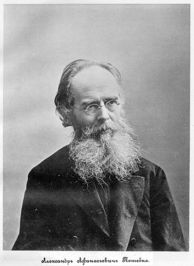


Oleksander Potebnja
Born
in Ukraine
September 22, 1835
Died
December 11, 1891
Genre
Influences
Wilhelm von Humboldt, J. G. Herder, H. Steinthal, J. Herbart, H. Lotze
...more


|
З лекцій теорії словесности. Байка, прислів'я, приповідка
—
published
1894
—
3 editions
|
|

|
الفكر واللغة
by
—
published
1892
—
4 editions
|
|

|
Слово о полку Игореве: Текст и примечания
by |
|

|
Мова, національність, денаціоналізація
by
—
published
1992
|
|

|
Language and Nationality
by
—
published
1895
|
|

|
Український буквар : по підручнику А. Потебні
by
—
published
1906
|
|

|
Переправа черезъ воду, какъ представление брака
—
published
1868
|
|
|
|
Lʹvivsʹka potebniana: Materialy naukovykh chytanʹ, prysvi͡a︡chenykh 160-richchi͡u︡ z dni͡a︡ narodz͡h︡enni͡a︡ Oleksandra Potebni, 21 veresni͡a︡ 1995 r
|
|

|
Естетика і поетика слова
—
published
1985
|
|

|
Ударение
by
—
published
1973
|
|
“Дети выучиваются языку взрослых только потому, что при других обстоятельствах могли бы создать свой.”
― Мысль и языкъ
― Мысль и языкъ
“Ideas begin to guide life only afterwards, after long periods that are required for their transformation, so to speak, into the black soil of thought, that is, into something that is no longer a subject for discussion.”
― Language and Nationality
― Language and Nationality
“Искусство есть язык художника, и как посредством слова нельзя передать другому своей мысли, а можно только пробудить в нем его собственную, так нельзя ее сообщить и в произведении искусства; поэтому содержание этого последнего (когда оно окончено) развивается уже не в художнике, а в понимающих. Слушающий может гораздо лучше говорящего понимать, что скрыто за словом, и читатель может лучше самого поэта постигать идею его произведения. Сущность, сила такого произведения не в том, что разумел под ним автор, а в том, как оно действует на читателя или зрителя, следовательно, в неисчерпаемом возможном его содержании. Это содержание, проецируемое нами, то есть влагаемое в самое произведение, действительно условлено его внутренней формой, но могло вовсе не входить в расчеты художника, который творит, удовлетворяя временным, нередко весьма узким потребностям своей жизни.”
―
―
Polls

Which of the following works of the Ukrainian culture should be translated into English primarily?
1) " History of the Rus' or Little Russia" (a historical and political essay);
2) "Three Leaves Beyond the Window" by Valerii Shevchuk (a novel);
3) "From Lectures on the Theory of Literature: The Fable, the Adage, the Proverb" by Aleksander Potebnja (a study, series of lectures);
4) "Mary" by Taras Shevchenko (an apocryphal poem)
5) None of the above.
6) Your variant.
1) " History of the Rus' or Little Russia" (a historical and political essay);
2) "Three Leaves Beyond the Window" by Valerii Shevchuk (a novel);
3) "From Lectures on the Theory of Literature: The Fable, the Adage, the Proverb" by Aleksander Potebnja (a study, series of lectures);
4) "Mary" by Taras Shevchenko (an apocryphal poem)
5) None of the above.
6) Your variant.
The image of Mary in Shevchenko's poem "Maria" (Mary, 1859) has not much in common with theological image of the Virgin. The biblical story is the only external drive for fully independent expression of the poet.
According to Ivan Franko and Boris Pasternak, who's translated the poem into Russian, it is the best Shevchenko's work.
According to Ivan Franko and Boris Pasternak, who's translated the poem into Russian, it is the best Shevchenko's work.
History of the Rus' or Little Russia (Russian: Исторія Русовъ, или Малой Россіи) or History of the Rus' (Ukrainian: Історія русів) is a book about the history of the Rus' people (Ruthenians) and their state (Ruthenia or Little Russia) from ancient times up to 1769. The book was written as a political essay in the end of the 18th century by anonymous author and firstly published in 1846 in Moscow in Russian language by Osyp Bodianski.
History of the Rus focuses on two ideas. Firstly, it emphasize the historical difference and antagonism between Rus' (Ukraine) and Muscovy (Russia). Secondly, it accentuate on the historical continuity of the Rus' people (Ukrainians) from the medieval times of Kievan Rus' till the early modern Cossack state.
Despite numerous factual mistakes and exaggerations, History of the Rus' had a great impact on Ukrainian scholarship, works of prominent Ukrainian writers like Nikolai Gogol and Taras Shevchenko, and formation of Ukrainian national discourse of the 19th century.
History of the Rus focuses on two ideas. Firstly, it emphasize the historical difference and antagonism between Rus' (Ukraine) and Muscovy (Russia). Secondly, it accentuate on the historical continuity of the Rus' people (Ukrainians) from the medieval times of Kievan Rus' till the early modern Cossack state.
Despite numerous factual mistakes and exaggerations, History of the Rus' had a great impact on Ukrainian scholarship, works of prominent Ukrainian writers like Nikolai Gogol and Taras Shevchenko, and formation of Ukrainian national discourse of the 19th century.
Valerii Shevchuk's second major prose work Три листки за вікном (Three Leaves Beyond the Window, 1986), a three-part novel that traced the secularization of Ukraine and spiritual decay of its intellectual elite through the 17th, 18th, and 19th century. Recognized as a exemplary literary work of the glasnost period, this novel earned Shevchuk the Shevchenko Prize in 1988. A film based on one of the parts of the novel and entitled "Диво в краю забуття" (A Wonderful Event in the Land of Forgetfulness) was produced in 1991 by Natalia Motuzko.
4
(write-in)
None of the above
2
(write-in)
According to Aleksander Potebnja's theory, literature is a hierarchy of genres; the simplest ones (the proverb, riddle, and fable) directly recall or renew the word's internal form, and the other genres do so in a more complicated, sometimes hardly detectable, way through a complex system of subjective (in poetry) or seemingly objective (in the novel) images. Potebnia's principal work on this subject were published posthumously: Iz Lekcii Po Teorii Slovesnosti: Basnja; Poslovica; Pogovorka (From Lectures on the Theory of Literature: The Fable, the Adage, the Proverb, 1894).
