

Who are The Hecateae?
In issue 2 Neil Gaiman’s The Sandman we are introduced to a trio of witches known as The Hecateae. Someone in my Sandman Facebook group asked me about them. Part of why you might not know who they are is because Neil accidentally invented a new spelling for the name.
The original spelling should probably have been Hecataea. It all originates with Hecate, the Greek Goddess of magick and witchcraft. In modern neo-Paganism the concept of the Triple Goddess is very popular. Maiden, Mother, and Crone.
Their sigil is usually the waxing, full, and waning moon respectively.
Neil Gaiman uses the Maiden, Mother, and Crone a lot in The Sandman. With the Hecataea, and Eve, for example. Eve can transform to a Maiden form, Mother, and Crone. And the story behind this is told in issue 40 of The Sandman, A Parliament of Rooks. The story talks about how Adam may have had three wives, or they may have all been the same woman. And how “both” are true.
Three women, as a powerful magical force, is popular in folklore and mythology. There’s also The Fates of Greek Mythology, and the Furies AKA The Kindly Ones. The Norse had The Norns. In The Sandman Neil treats them all as aspects of the same entity.
When Morpheus summons The Hecataea in issue 2 of The Sandman “Imperfect hosts” he refers to them as Clotho, Lachesis, and Atropos. This is the name of the Fates (Moirai) in mythology. However these characters answer to Cynthia, Mildred and Mordred (Sometimes corrected to Morgan or Morgain). This is because The Three Witches used these names in their own horror anthology comic “The Witching Hour.” Nearly every character introduced in The Sandman issue 2 was an old horror anthology comic host. The title of the issue was a pun. “Imperfect hosts.”
The horror hosts introduced in this issue are Cain, Abel, Lucien, The Three Witches (The Hecataea), Eve (Also known as The Raven Woman), The Mad Mod Witch (Fashion Thing), and Destiny (now Destiny of The Endless). Cain, who began as DC’s equivalent to EC’s The Crypt Keeper, hosted The House of Mystery. Abel hosted The House of Secrets. Lucien hosted Tales of Ghost Castle (which is retroactively Morpheus’s castle in The Sandman). The Three witches hosted The Witching Hour. You get the idea.
But before they were even horror hosts, the trio was an architype common in folklore and popular culture. You will find that in most works of folklore and fiction if it’s not a witch acting alone, she’s usually in a coven of three. They’re not literally a Maiden (virgin or child-like), Mother, and Crone. Sometimes they just fit the physical appearance or personalities heavily associated with these concepts.
A popular famous example of this is Disney’s Hocus Pocus. Winifred, the leader, is the Crone of the group as she is the leader and most cantankerous. She’s also the eldest sister. Mary, the middle sister, is a bit heavier and is maternal toward her sisters. She loves food and loves to cook and care for her siblings. This is the mother. And Sarah (though not virginal) is the most child-like. Much like Cynthia in The Hecataea, she is surprisingly sensual and a bit dim.
Another good example is Terry Pratchett’s Wyrd Sisters who served as a parody on the trope, particularly from Shakespeare’s famous play.
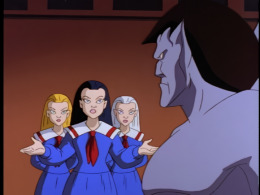
Disney’s Gargoyles even had a version of The Sisters. In that continuity they are of Oberon’s court, meaning that they are fae folk. But much like The Endless in Neil Gaiman’s The Sandman their appearance changes based on who is addressing them. Goliath and his clan of Gargoyles saw them as human children. Demona saw them as woman Gargoyles (as she does not like or trust humans). MacBeth saw them as human women.

There’s also the Hex Girls in Scooby Doo and The Witch’s Ghost.
A helpful version of the three appear in the Fairy tale The Three Spinners where, like Rumpelstiltskin, they aid a girl who is forced to spin for a king.
Once you start to notice it, you realize the three turn up a lot in pop culture. It’s also common in religion. In Christianity there’s The Father, son, and Holy Spirit. Goethe’s Faust has Pagan roots despite its use of demons, Angels, and God. In fact the entity at the end may well be the Triple Goddess as she is referred to as “Virgin, Mother, and now Queen. Goddess grant your mercies.” - A. S. Kline translation of Goethe’s Faust Part 2. It’s no surprise that this also fits the Virgin Mary. A Maiden and a Mother, and also Queen (as opposed to Crone).
Note: Sometimes the Maiden, Mother, and Crone are actually referred to as Maiden, Mother, and Queen as it’s considered more respectful.
In The Sandman, at one point, Morpheus refers to the three-in-one as Witch Queen.
Again, this is because of the roots with Hecate, Goddess of Magick and spells. The neopagan popularity of The Triple Goddess also helps perpetuate the archetype. Almost every witch coven has three (sometimes four) members. Three is considered the sacred number. And once you notice it, you’ll start to see the Maiden, Mother, and Crone in a lot of things.
I will also point out here that though it’s popular to consider Midnight The Witching Hour, the actual traditional Witching Hour is three AM or as Ray Bradbury called it in Something Wicked This way Comes, The Soul’s Midnight.
Neil Gaiman takes the Hecataea and also uses The three-in-one for The Furies AKA The Kindly Ones.
Maiden, Mother, Crone
I’m not sure how many Hocus Pocus fans realized this but there’s a subtle nod to the Triple Goddess in Hocus Pocus.
Sarah - The Maiden. Not necessarily virginal but the youngest and most child-like of the group.
Mary - The Mother. Loves to cook, is maternal and protective with her sisters, and has a parental disposition.
Winifred - The Crone. The Oldest and most authoritative of the trio and the one most likely to punish or kill.